Journal
NAD+ for Skin: How This Cellular Fuel Supports Recovery and Anti-Aging
Every function your skin performs requires energy. Repairing damage, producing collagen, fighting oxidative stress, maintaining barrier integrity, turning over cells, and...
March 21, 2026 / 9 min read

Every function your skin performs requires energy. Repairing damage, producing collagen, fighting oxidative stress, maintaining barrier integrity, turning over cells, and healing after procedures all demand significant cellular fuel. When that fuel runs low, everything slows down. Recovery takes longer, aging accelerates, and skin loses its resilience and vitality.
This is where NAD+ enters the conversation. Nicotinamide adenine dinucleotide, known as NAD+, is not a trendy new discovery but a fundamental molecule that your cells have always depended on. Scientists have understood its importance in cellular biology for decades. What is new is the recognition that declining NAD+ levels contribute significantly to skin aging and impaired recovery, and that topical application can help address this decline.
Understanding NAD+ reveals why some skin simply functions better than others, why recovery slows as we age, and what we can do to support our skin at the most fundamental cellular level.
What Is NAD+?
NAD+ is a coenzyme present in every living cell of your body. It plays a central role in metabolism, converting the nutrients you consume into the cellular energy your cells need to function. Without adequate NAD+, your cells simply cannot perform their essential tasks efficiently.
At its core, NAD+ is a redox cofactor, meaning it participates in oxidation-reduction reactions that transfer electrons during metabolic processes. The practical implication is straightforward: NAD+ is essential for producing ATP, the energy currency your cells spend to do everything they do.
Beyond energy production, NAD+ serves as a critical substrate for several enzyme families that regulate cellular health. It is not simply fuel but also a signaling molecule that influences how your cells respond to stress, repair damage, and maintain their function over time.
The challenge is that NAD+ levels decline significantly with age. By middle age, your NAD+ levels may be half what they were in your youth. This decline correlates with many hallmarks of aging, including reduced cellular energy, impaired DNA repair, increased oxidative damage, and slower recovery from injury or stress.
How NAD+ Works in Your Skin
Understanding the specific mechanisms through which NAD+ benefits skin reveals why it is so valuable for both recovery and anti-aging applications.
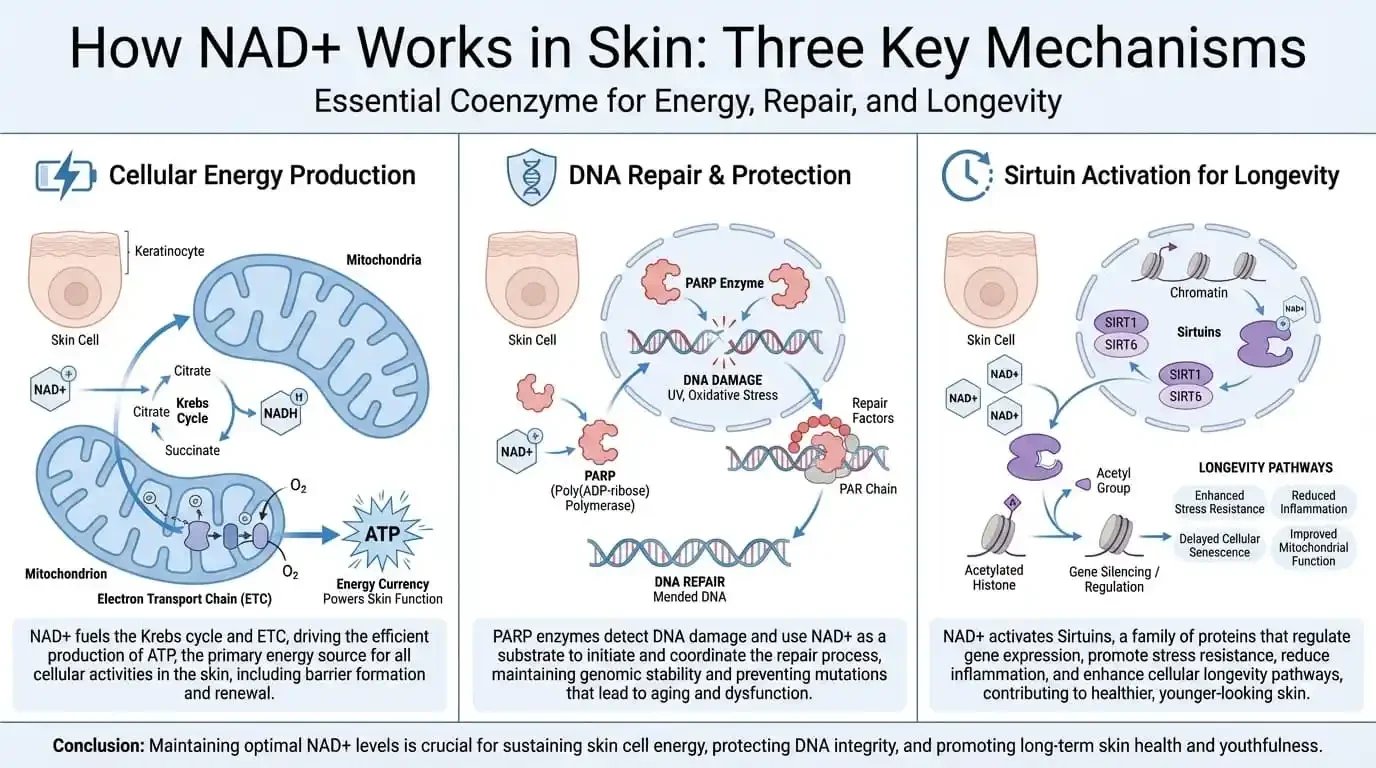
Powering Cellular Energy Production
Your skin cells are constantly working. They produce proteins, maintain structures, fight pathogens, repair damage, and turn over regularly. All of this activity requires ATP, and NAD+ is essential for ATP production through cellular respiration.
When NAD+ levels are adequate, your skin cells have the energy they need to function optimally. When levels decline, cellular processes slow down. This is why aging skin often shows reduced collagen production, slower wound healing, and diminished barrier function. The cells are still capable of performing these functions, but they lack sufficient fuel.
Supporting DNA Repair Through PARPs
Your skin is constantly exposed to DNA-damaging stressors including UV radiation, pollution, and oxidative stress. Healthy skin relies on robust DNA repair mechanisms to fix this damage before it accumulates.
PARPs, or poly ADP-ribose polymerases, are enzymes critically involved in DNA repair. When DNA damage occurs, PARPs are activated to coordinate the repair response. The crucial point: PARPs require NAD+ as a substrate to function. Without adequate NAD+, PARP activity is limited, and DNA repair becomes less efficient.
This connection has significant implications for skin health. Accumulated DNA damage contributes to cellular dysfunction, premature aging, and increased risk of skin problems. Supporting NAD+ levels helps ensure your DNA repair machinery has the resources it needs.
Activating Sirtuins for Cellular Longevity
Sirtuins are a family of proteins often called longevity enzymes because of their role in regulating cellular health and lifespan. These enzymes influence numerous processes relevant to skin aging, including inflammation, oxidative stress response, and cellular senescence.
Like PARPs, sirtuins require NAD+ as a substrate. When NAD+ is abundant, sirtuin activity is supported. When NAD+ declines, sirtuin function diminishes, and many protective cellular processes become less effective.
Sirtuin activation has been linked to improved mitochondrial function, reduced inflammation, enhanced stress resistance, and delayed cellular senescence. By supporting NAD+ levels, you indirectly support this entire network of protective mechanisms.
Counteracting Cellular Senescence
Cellular senescence occurs when cells stop dividing and enter a dysfunctional state. Senescent cells accumulate with age and contribute to tissue dysfunction through the inflammatory signals they release. In skin, senescent cells contribute to thinning, reduced elasticity, impaired healing, and other signs of aging.
Research suggests that declining NAD+ levels contribute to the accumulation of senescent cells. By maintaining healthier NAD+ levels, you may help delay the onset of senescence and support more youthful cellular function over time.
NAD+ Benefits for Skin Recovery
The cellular mechanisms described above translate into specific benefits when your skin is recovering from aesthetic procedures.
Accelerated Healing
Recovery from procedures like microneedling, laser treatments, or chemical peels requires intensive cellular work. Cells must repair damage, produce new tissue, rebuild the barrier, and resolve inflammation. All of this demands significant energy.
By supporting NAD+ levels during recovery, you provide your skin cells with the fuel they need for efficient repair. Cells can work at full capacity rather than being limited by energy constraints. This translates to faster visible recovery and better outcomes.
Enhanced Barrier Repair
Your skin barrier depends on healthy, well-functioning cells to maintain its integrity. After procedures that compromise the barrier, rapid repair is essential for protecting vulnerable new skin and preventing complications.
NAD+ supports the cellular processes underlying barrier reconstruction. Cells have the energy to produce the lipids, proteins, and other components needed for barrier function. The result is faster restoration of protective barrier integrity.
Reduced Oxidative Stress
Procedures create oxidative stress as part of the healing cascade. While some oxidative signaling is necessary for repair, excessive oxidative stress damages cells and prolongs recovery.
NAD+ supports your cells' antioxidant defenses and helps manage oxidative stress more effectively. This protection enables healthier healing with less collateral damage to surrounding tissue.
NAD+ Benefits for Anti-Aging
Beyond recovery, NAD+ offers significant benefits for long-term skin health.
Increased Collagen Production
Collagen synthesis is an energy-intensive process. Fibroblasts, the cells responsible for producing collagen, require substantial ATP to manufacture these structural proteins. When cellular energy is limited, collagen production declines.
By supporting NAD+ levels, you provide fibroblasts with the energy they need for robust collagen synthesis. This helps maintain skin firmness and reduces the appearance of fine lines and wrinkles over time.
Improved Cellular Function and Skin Quality
When skin cells operate with adequate energy, every aspect of their function improves. Cellular turnover proceeds at a healthy rate, barrier maintenance is more consistent, and repair mechanisms respond promptly to daily micro-damage. The cumulative effect is skin that looks healthier, more vibrant, and more resilient. This whole-cell optimization is what distinguishes NAD+ from ingredients that target only one visible symptom of aging.
Enhanced Cellular Resilience
Skin with adequate NAD+ is more resilient to daily stressors. Cells can respond to challenges more effectively, repair minor damage before it accumulates, and maintain their function despite environmental assaults. This resilience translates to skin that ages more gracefully over time.
Addressing the Hallmarks of Aging
Scientists have identified specific hallmarks of biological aging, including mitochondrial dysfunction, genomic instability, cellular senescence, and altered intercellular communication. NAD+ decline is connected to several of these hallmarks.
By supporting NAD+ levels, you address aging at a fundamental level rather than simply treating surface symptoms. This approach supports healthier cellular function that manifests as healthier, more youthful-appearing skin.
Why NAD+ Concentration Matters
As with any active ingredient, the concentration of NAD+ in a formulation significantly impacts its effectiveness. Products containing trace amounts may not deliver meaningful benefits.
Effective NAD+ formulations typically contain the ingredient at 1% concentration or 10,000 PPM. At this level, NAD+ can meaningfully support cellular energy production and enzymatic function. Lower concentrations may provide some benefit but are unlikely to produce the significant effects documented in research.
When evaluating NAD+ products, look for formulations that specify concentration. Products simply listing NAD+ without concentration information may contain minimal amounts included primarily for marketing appeal rather than efficacy.
Why NAD+ Works Best With Complementary Technologies
While NAD+ is powerful on its own, it delivers optimal results as part of a comprehensive formulation. Cellular energy is essential, but cells also need signaling, repair substrates, and communication support to function optimally. NAD+ is the fuel, but fuel alone does not build a house. You also need blueprints, materials, and coordination.
Plant exosomes complement NAD+ by supporting intercellular communication and modulating inflammation. They help coordinate the cellular responses that NAD+ energizes.
PDRN activates tissue regeneration pathways through adenosine receptor signaling, providing repair signals that work synergistically with NAD+-fueled cellular energy.
Peptides and growth factors provide additional regenerative signals, directing the repair and renewal processes that NAD+ makes possible.
Nexovia Skin Serum was formulated around this principle. NAD+ at 1% (10,000 PPM) is one of four core bio-amplifiers in the ABA.4 architecture, working alongside plant exosomes at 4 billion particles per milliliter, PDRN at 1%, and a peptide matrix including EGF-mimetics and matrikines. NAD+ provides the cellular energy. The other three technologies provide the communication, repair signals, and structural blueprints. Together, they deliver what no single ingredient can achieve alone.
Want to know if NAD+-powered recovery is right for your skin?
Frequently Asked Questions
Is topical NAD+ as effective as oral supplements?
Topical and oral NAD+ work differently. Oral supplements aim to raise systemic NAD+ levels throughout the body, while topical application delivers NAD+ directly to skin cells where it can be utilized locally. For skin-specific benefits, topical application ensures the ingredient reaches the cells that need it most. Many people use both approaches for comprehensive support.
Can I use NAD+ products every day?
Yes, NAD+ products are appropriate for daily use. Supporting cellular energy is beneficial for ongoing skin health, not just recovery from specific treatments. Consistent use helps maintain optimal cellular function over time. Nexovia Skin Serum is designed for both post-procedure recovery and ongoing daily use, with a protocol that transitions from intensive application during healing to daily maintenance.
Will NAD+ help with skin sensitivity?
NAD+ supports overall cellular health and function, which can contribute to more resilient, less reactive skin over time. While it is not specifically an anti-sensitivity ingredient, skin with adequate cellular energy and robust repair mechanisms tends to be more resilient to irritants and stressors.
How long does it take to see results from NAD+ skincare?
For post-procedure recovery, NAD+ benefits are experienced during the healing period itself as cellular energy supports efficient repair. For anti-aging benefits, consistent daily use post aesthetic procedure is a must to see noticeable improvements in skin texture, firmness, and overall vitality as cumulative cellular benefits manifest visibly.
Does NAD+ interact with other skincare ingredients?
NAD+ is compatible with most skincare ingredients and works synergistically with many actives. It complements rather than conflicts with ingredients like hyaluronic acid, peptides, niacinamide, and antioxidants. The cellular energy NAD+ provides actually enhances your skin's ability to benefit from other ingredients by ensuring cells have the fuel to utilize them effectively.
This content is for informational purposes only and does not constitute medical advice. Always follow the specific aftercare instructions provided by your practitioner, as recommendations may vary based on your individual treatment and skin type.


