Journal
PDRN in Skincare: What It Is, How It Works, and Why It Matters
If you follow skincare trends, you have likely noticed a new ingredient appearing in Korean beauty products and aesthetic clinic conversations: PDRN. This compound,...
February 17, 2026 / 9 min read

If you follow skincare trends, you have likely noticed a new ingredient appearing in Korean beauty products and aesthetic clinic conversations: PDRN. This compound, polydeoxyribonucleotide, has moved from medical wound healing applications into the spotlight of advanced skincare formulations. Korean aesthetic medicine embraced PDRN years ago, and now the global beauty world is catching on to what K-Beauty insiders have known: this ingredient delivers remarkable tissue repair benefits that few other actives can match.
But what exactly is PDRN, and why has it generated such excitement? Unlike trendy ingredients that offer modest benefits with maximum marketing, PDRN has a substantial body of research supporting its regenerative capabilities. It works through specific biological pathways to support tissue repair at the cellular level, making it particularly valuable for skin that needs more than surface-level hydration or gentle exfoliation.
This guide explains everything you need to know about PDRN in skincare, from the science behind how it works to the specific benefits it offers, especially for post-procedure recovery.
What Is PDRN?
PDRN stands for polydeoxyribonucleotide, a compound derived from DNA fragments. In skincare formulations, it is typically listed as Sodium DNA on ingredient labels. These DNA fragments are purified biological molecules that your skin cells can utilize to support repair and regeneration processes.
The ingredient has a long history in medical applications. PDRN has been used for decades in clinical settings to support wound healing, treat tissue damage, and promote regeneration in compromised skin. Physicians have administered it through injections for conditions ranging from diabetic ulcers to surgical wound healing, with documented success in accelerating tissue repair.
Korean aesthetic medicine recognized the potential for topical application and began incorporating PDRN into skincare formulations and in-clinic treatments. The ingredient became a staple in Korean dermatology clinics for post-procedure care, where its tissue repair capabilities proved particularly valuable for patients recovering from laser treatments, microneedling, and chemical peels.
Now, as K-Beauty continues influencing global skincare trends, PDRN is gaining recognition beyond Korea as one of the most effective regenerative ingredients available in topical formulations.
How PDRN Works in Your Skin
Understanding the mechanism behind PDRN helps explain why it delivers such significant benefits. Unlike many skincare ingredients that work primarily at the surface level, PDRN engages specific cellular pathways that influence tissue repair from within.
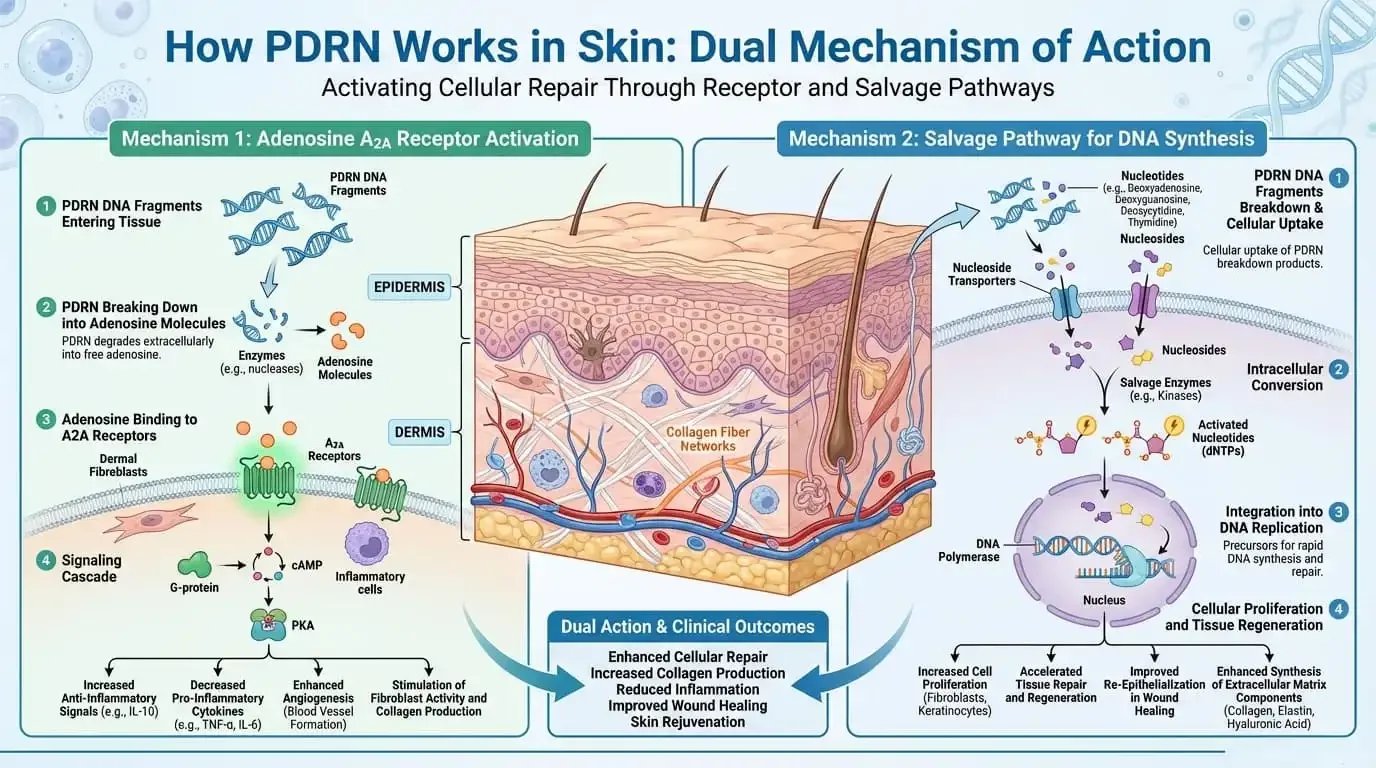
Adenosine A2A Receptor Activation
The primary mechanism through which PDRN works involves adenosine A2A receptors on your skin cells. When PDRN binds to these receptors, it triggers a signaling cascade that promotes tissue regeneration.
This signaling pathway, known as the cAMP to PKA to VEGF pathway, initiates several beneficial processes. VEGF, or vascular endothelial growth factor, promotes the formation of new blood vessels that bring oxygen and nutrients to healing tissue. This improved circulation supports faster, more efficient repair.
The adenosine A2A receptor pathway also has significant anti-inflammatory effects. By modulating inflammatory signaling, PDRN helps your skin move through the inflammatory phase of healing more efficiently, reducing prolonged redness and irritation while supporting the transition to active tissue regeneration.
Nucleotide Salvage Pathway Activation
PDRN also activates nucleotide salvage pathways in your cells. Nucleotides are the building blocks your cells use to construct new DNA and RNA. When your skin is healing, cells need abundant nucleotides to replicate and produce the proteins required for tissue repair.
By providing a source of nucleotide building blocks and activating salvage pathways, PDRN supports your cells in synthesizing the materials they need for efficient regeneration. This is particularly valuable when your skin is under repair stress and cellular demands are high.
Collagen Synthesis Support
Research demonstrates that PDRN promotes de novo collagen synthesis, meaning it supports your skin in producing new collagen rather than simply protecting existing collagen from breakdown. This makes it valuable not only for wound healing but also for anti-aging applications where increased collagen production improves skin firmness and elasticity.
The Benefits of PDRN in Skincare
The biological mechanisms described above translate into several tangible benefits for your skin.
Accelerated Wound Healing
PDRN's most well-documented benefit is its ability to support wound healing. The combination of improved circulation through VEGF promotion, reduced inflammation via adenosine A2A signaling, and enhanced cellular building blocks through nucleotide salvage creates optimal conditions for tissue repair. Skin recovers faster from injury, whether that injury is a cut, a burn, or controlled damage from an aesthetic procedure.
Enhanced Barrier Repair
Your skin barrier relies on healthy, well-functioning cells to maintain its integrity. PDRN supports the cellular processes underlying barrier function, helping compromised skin rebuild its protective outer layer more efficiently. This is particularly relevant after procedures that intentionally disrupt the barrier, such as microneedling, laser treatments, and chemical peels.
Reduced Inflammation and Redness
The anti-inflammatory effects of adenosine A2A receptor activation help calm irritated, reactive skin. For post-procedure patients, this translates to faster resolution of visible redness. For general skincare users, it benefits anyone dealing with inflammatory skin concerns. For more on managing post-procedure redness specifically, see our guide on how to reduce redness after laser treatment.
Improved Skin Texture and Firmness
By supporting de novo collagen synthesis, PDRN contributes to improved skin texture and firmness over time. The regenerative processes it promotes result in healthier, more resilient skin with better structural integrity.
Support for Even-Toned Healing
By helping skin move through the inflammatory phase efficiently, PDRN indirectly reduces the risk of post-inflammatory hyperpigmentation. Prolonged inflammation is one of the primary triggers for melanocyte overactivity. When inflammation resolves faster, the window during which pigmentation problems can develop is shortened. For a deeper look at this topic, see our guide on preventing hyperpigmentation after aesthetic procedures.
Why PDRN Is Ideal for Post-Procedure Skincare
While PDRN offers benefits for general skincare use, its properties make it exceptionally well-suited for post-procedure recovery. After aesthetic treatments, your skin faces specific challenges that align precisely with PDRN's mechanisms of action.
Aesthetic procedures create controlled injury. Whether you have undergone microneedling, laser resurfacing, chemical peels, or IPL, your skin has experienced intentional damage designed to trigger regeneration. PDRN supports exactly this regenerative response, helping your skin capitalize on the healing cascade your procedure initiated.
Post-procedure skin is inflamed. The inflammatory phase is necessary for healing but can become problematic if prolonged. PDRN helps modulate this inflammation, supporting your skin in transitioning from the inflammatory phase to active tissue repair more efficiently.
Barrier compromise is universal after procedures. Regardless of the specific treatment, your barrier function is impaired during recovery. PDRN supports the cellular processes underlying barrier reconstruction, helping your skin rebuild its protective function faster.
Cellular demands are elevated. Healing requires significant cellular resources. PDRN provides nucleotide building blocks and activates salvage pathways that support your cells in meeting these elevated demands, enabling more efficient repair.
PDRN Concentration Matters
Not all PDRN products are created equal. The concentration of active ingredient significantly impacts efficacy. Many products include PDRN at token amounts that may not deliver meaningful benefits.
Effective PDRN formulations typically contain the ingredient at 1% concentration or 10,000 PPM. At this level, PDRN can meaningfully engage the adenosine receptor pathways and support tissue regeneration. Lower concentrations may provide some benefit but are unlikely to deliver the significant results documented in research.
When evaluating PDRN products, look for formulations that specify concentration. Products listing PDRN or Sodium DNA without concentration information may contain minimal amounts included primarily for label appeal rather than efficacy.
Why PDRN Works Best in Multi-Technology Formulations
While PDRN is powerful on its own, it delivers optimal results when combined with complementary ingredients that address other aspects of skin health and recovery. Post-procedure skin faces multiple simultaneous challenges, and a single ingredient, however effective, cannot address all of them optimally.
Plant exosomes complement PDRN by supporting intercellular communication and modulating inflammation through different pathways. NAD+ addresses cellular energy needs, fueling the repair processes PDRN initiates. Peptides and growth factors provide additional regenerative signaling, amplifying the tissue rebuilding response.
This synergistic approach reflects how Korean aesthetic medicine actually uses PDRN in clinical settings: as part of comprehensive protocols rather than as a standalone solution. The most sophisticated formulations engineer these complementary ingredients to work together, amplifying each other's benefits rather than simply coexisting in the same bottle.
Nexovia Skin Serum was formulated with this exact philosophy. PDRN at 1% concentration (10,000 PPM) is one of four core bio-amplifiers in the ABA.4 architecture, working alongside plant exosomes at 4 billion particles per milliliter, NAD+ at 1%, and a peptide matrix including EGF-mimetics and matrikines. Each technology addresses a different aspect of skin recovery and health, and together they deliver results that no single ingredient can achieve alone.
Want to know if a PDRN-based recovery protocol is right for your skin?
Frequently Asked Questions
Is PDRN safe for all skin types?
PDRN has an excellent safety profile across skin types. Its biological compatibility and anti-inflammatory properties make it well-tolerated even by sensitive skin. Because it supports natural healing processes rather than introducing harsh actives, PDRN is appropriate for most individuals. As with any skincare ingredient, patch testing is advisable if you have highly reactive skin.
How is PDRN different from other DNA-based skincare ingredients?
PDRN refers specifically to polydeoxyribonucleotide fragments that engage adenosine A2A receptors and support nucleotide salvage pathways. Not all DNA-derived ingredients work through these specific mechanisms. When evaluating products, look for PDRN or Sodium DNA specifically, and verify concentration to ensure you are getting an effective form of this ingredient.
Can I use PDRN products daily or only after procedures?
PDRN products can be used both for post-procedure recovery and as part of a daily skincare routine. The tissue repair and collagen synthesis benefits support ongoing skin health, not just recovery from specific treatments. However, PDRN's benefits are particularly pronounced when skin is actively healing and cellular demands are elevated. Nexovia Skin Serum is designed for both use cases, with a protocol that transitions from intensive post-procedure application to ongoing daily maintenance.
How long does it take to see results from PDRN?
When used for post-procedure recovery, PDRN's benefits in supporting healing are experienced during the recovery period itself, typically within the first one to two weeks. For general anti-aging and skin quality benefits, consistent use over four to eight weeks typically produces noticeable improvements in skin texture, firmness, and overall health.
Why is PDRN so popular in Korean skincare?
Korean aesthetic medicine has long emphasized regeneration and healing over aggressive correction. PDRN aligns perfectly with this philosophy, supporting the skin's natural repair processes rather than overriding them. Korean dermatologists and aesthetic practitioners adopted PDRN for post-procedure care years ago, and its proven benefits in clinical settings naturally extended into retail skincare products as consumers sought similar results at home. Nexovia was developed in South Korea within this tradition, incorporating PDRN at clinically meaningful concentration as part of its ABA.4 Bio-Intelligent Architecture.
This content is for informational purposes only and does not constitute medical advice. Always follow the specific aftercare instructions provided by your practitioner, as recommendations may vary based on your individual treatment and skin type.


