Journal
Peptides for Skin Barrier Repair: What the Science Says
Your skin barrier is under constant assault. Environmental stressors, harsh products, over-exfoliation, and aesthetic procedures all challenge its integrity. When the barrier...
March 24, 2026 / 9 min read

Your skin barrier is under constant assault. Environmental stressors, harsh products, over-exfoliation, and aesthetic procedures all challenge its integrity. When the barrier becomes compromised, you experience the consequences: dryness, sensitivity, redness, irritation, and skin that simply does not look or feel healthy. Rebuilding that barrier requires more than passive moisturization. It requires active signaling that tells your skin cells to ramp up repair.
This is where peptides enter the picture. These small protein fragments have become one of the most researched and validated ingredient categories in skincare science. Unlike many trendy ingredients that rely more on marketing than evidence, peptides have substantial scientific backing demonstrating their ability to influence cellular behavior and support skin repair.
But not all peptides are created equal. This guide explains the science behind peptides for skin barrier repair, focusing on the specific peptides with demonstrated benefits for compromised and recovering skin.
What Are Peptides?
Peptides are short chains of amino acids, the building blocks of proteins. While proteins like collagen and elastin contain hundreds or thousands of amino acids, peptides are smaller fragments typically containing between two and fifty amino acids linked together.
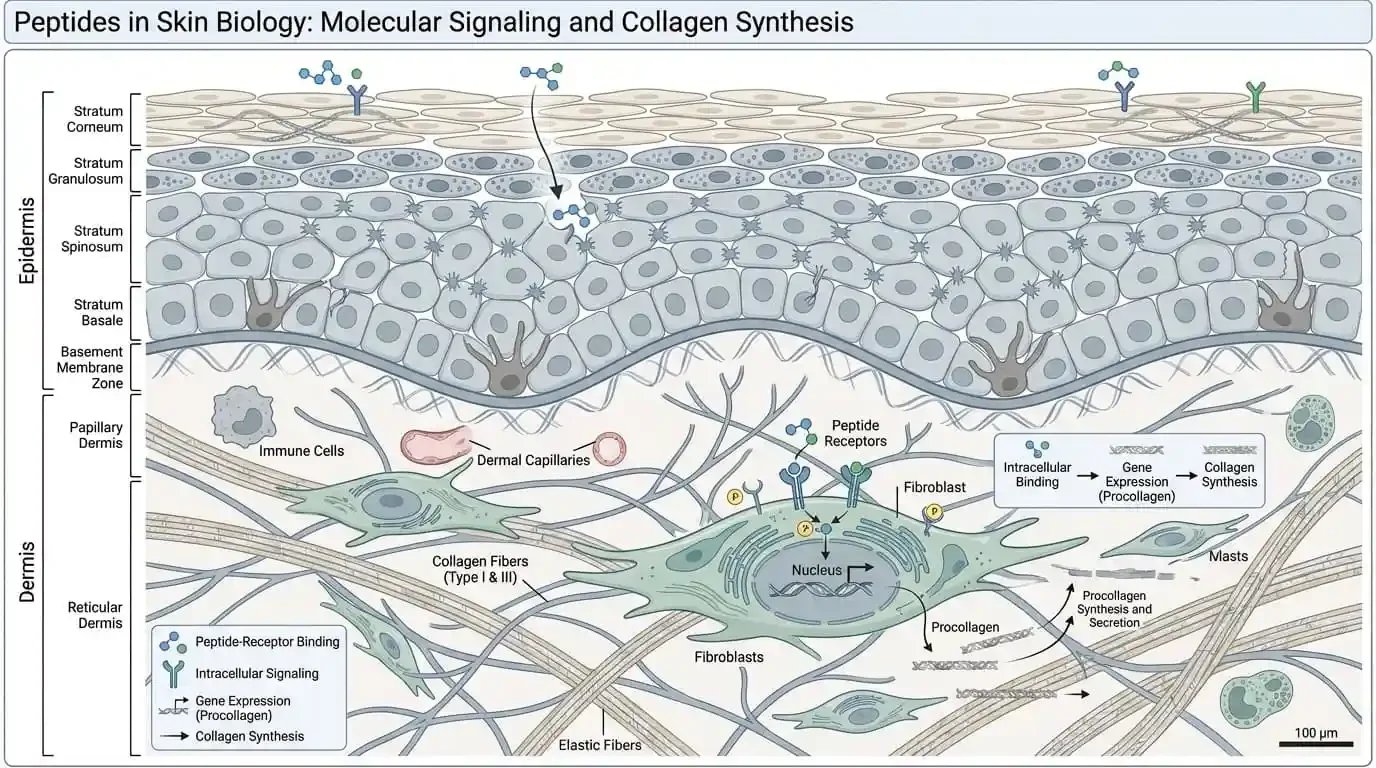
What makes peptides valuable in skincare is their ability to act as signaling molecules. Your skin cells have receptors that recognize specific peptide sequences. When a peptide binds to its receptor, it triggers a cellular response, essentially delivering a message that instructs the cell to perform a particular function.
Different peptide sequences deliver different messages. Some signal cells to produce more collagen. Others trigger wound healing responses. Some modulate inflammation. Others influence muscle contraction. The specific amino acid sequence determines the message the peptide carries.
This signaling capability makes peptides fundamentally different from passive ingredients that simply sit on the skin or provide hydration. Peptides actively communicate with your cells, influencing their behavior in targeted ways that support repair and regeneration.
How Peptides Support Skin Barrier Repair
Your skin barrier is a complex structure requiring continuous maintenance and active repair when damaged. The barrier depends on healthy cells producing appropriate structural components, adequate lipid production, proper cellular turnover, and coordinated communication between different cell types.
Peptides support barrier repair through several mechanisms. They signal keratinocytes to produce the proteins and lipids essential for barrier integrity. They activate fibroblasts to produce collagen and extracellular matrix components that provide structural support. They promote cellular renewal so damaged cells are replaced with healthy ones. They modulate inflammation that can impair healing if prolonged.
After aesthetic procedures that intentionally compromise the barrier, such as microneedling, laser treatments, or chemical peels, peptide signaling becomes particularly valuable. Your skin is already in repair mode, and peptides amplify and direct that repair response for more efficient recovery.
The Science Behind Key Peptides for Barrier Repair
Understanding the specific peptides with proven benefits helps you evaluate products and choose formulations that deliver meaningful results. The following peptides represent different categories with complementary mechanisms of action.
sh-Oligopeptide-1: The Cellular Renewal Signal
sh-Oligopeptide-1 is an EGF-mimetic peptide, meaning it mimics the activity of epidermal growth factor. EGF is a naturally occurring protein that plays a crucial role in wound healing and cellular renewal. It signals skin cells to proliferate and migrate, essential processes for repairing damaged tissue.
When applied topically, sh-Oligopeptide-1 binds to EGF receptors on keratinocytes and fibroblasts, triggering signaling cascades that promote cellular renewal. Research demonstrates that EGF-mimetic peptides accelerate wound healing, support faster re-epithelialization, and help restore barrier function more efficiently.
For post-procedure recovery, this peptide supports the rapid cellular turnover needed to replace damaged tissue with healthy new cells. The barrier rebuilds faster because the cells responsible for its construction are actively proliferating and functioning at enhanced capacity.
sh-Polypeptide-1: The Fibroblast Activator
sh-Polypeptide-1 mimics fibroblast growth factor (FGF), another key signaling protein in skin biology. FGF specifically targets fibroblasts, the cells responsible for producing collagen, elastin, and other extracellular matrix components that give skin its structure and resilience.
When fibroblasts receive FGF signals, they increase production of structural proteins and matrix components. This enhanced activity supports not only barrier repair but also the deeper dermal structures that provide foundation for healthy skin.
After procedures that create controlled injury to stimulate collagen remodeling, sh-Polypeptide-1 amplifies the fibroblast response. The cells are already activated by the treatment, and the peptide signal encourages them to produce even more of the structural components needed for optimal repair and rejuvenation.
Palmitoyl Pentapeptide-4 (Matrixyl): The Matrix Builder
Palmitoyl Pentapeptide-4, also known by the trade name Matrixyl, is one of the most extensively researched peptides in skincare. It belongs to the matrikine category: peptides that mimic fragments of extracellular matrix proteins and signal cells to produce more matrix components.
The science behind matrikines is elegant. When collagen breaks down naturally, it releases small peptide fragments. Your skin recognizes these fragments as signals that matrix repair is needed, triggering increased production of collagen and other structural proteins. Palmitoyl Pentapeptide-4 mimics these natural breakdown fragments, essentially triggering your skin to ramp up matrix production.
Research on Palmitoyl Pentapeptide-4 demonstrates increased collagen I, collagen IV, and fibronectin production. These structural proteins are essential for both the dermal matrix that provides skin firmness and the basement membrane that supports the epidermis and barrier function.
For barrier repair, this peptide supports the structural foundation underlying healthy barrier function. A strong, well-organized matrix provides the scaffolding on which the barrier is built and maintained.
Acetyl Hexapeptide-8 (Argireline): The Expression Modulator
Acetyl Hexapeptide-8, commonly known as Argireline, works through a different mechanism than the other peptides discussed. Rather than stimulating growth or matrix production, it modulates neurotransmitter release at the neuromuscular junction, reducing the intensity of muscle contractions that create expression lines.
This mechanism makes Argireline primarily an anti-aging peptide, softening the appearance of dynamic wrinkles around the eyes, forehead, and mouth. Within a comprehensive peptide matrix, Argireline adds an anti-aging dimension that complements the repair and regeneration signals of the other peptides. While the EGF-mimetics and matrikines rebuild your skin's structure, Argireline addresses the expression lines that structural repair alone cannot fully resolve.
Why Peptide Combinations Outperform Single Peptides
Your skin barrier is complex, and its repair involves multiple cell types, processes, and signaling pathways. No single peptide can address all aspects of barrier repair optimally. This is why formulations combining multiple peptides with complementary mechanisms deliver superior results.
EGF-mimetic peptides drive cellular renewal. FGF-mimetic peptides activate fibroblasts. Matrikines signal matrix production. Neurotransmitter modulators address expression lines. Together, these peptides address barrier repair and skin quality from multiple angles simultaneously.
This multi-peptide approach reflects how your skin naturally coordinates repair. Multiple growth factors and signaling molecules work together in the wound healing cascade. Formulations that provide multiple peptide signals more closely mimic this natural coordination, supporting more comprehensive and efficient repair.
Why Peptides Work Best With Complementary Technologies
Peptides are powerful signaling molecules, but signals alone are not enough. Your cells also need energy to execute those signals, communication support to coordinate their response, and repair substrates to build with.
Plant exosomes complement peptides by supporting intercellular communication through different pathways and modulating inflammation. While peptides signal specific cellular activities, exosomes help coordinate the overall cellular response.
PDRN activates tissue regeneration through adenosine receptor pathways, providing additional repair signals that work synergistically with peptide messaging.
NAD+ supplies the cellular energy needed to execute the activities peptides signal. Peptides tell cells what to do. NAD+ ensures cells have the fuel to follow those instructions. Without adequate energy, even the best signaling goes unanswered.
This is the core principle behind Nexovia's ABA.4 Bio-Intelligent Architecture. The peptide matrix (sh-Oligopeptide-1, sh-Polypeptide-1, Palmitoyl Pentapeptide-4, Acetyl Hexapeptide-8) provides the repair blueprints. Plant exosomes at 4 billion particles per milliliter coordinate the cellular response. PDRN at 1% activates regeneration pathways. NAD+ at 1% fuels the entire operation. Four technologies, each essential, each amplifying the others.
Want to see how a comprehensive peptide matrix can support your skin?
Frequently Asked Questions
How long does it take for peptides to repair the skin barrier?
Peptide benefits for barrier repair begin accumulating immediately as they signal cellular activities supporting repair. Noticeable improvements in barrier function typically become apparent within one to two weeks of consistent use. For post-procedure recovery, peptides support faster healing throughout the recovery period. For general barrier strengthening, four to eight weeks of consistent use produces meaningful improvements in barrier resilience.
Can peptides irritate sensitive or compromised skin?
Peptides are generally very well tolerated, even by sensitive and compromised skin. Because they work by signaling natural cellular processes rather than introducing harsh actives, they do not typically cause irritation. In fact, many peptides have soothing effects that benefit reactive skin. This makes peptides ideal for post-procedure use when skin is vulnerable.
Are peptides safe to use with other skincare ingredients?
Peptides are compatible with most skincare ingredients. They work well alongside hydrating ingredients like hyaluronic acid, soothing ingredients like Centella Asiatica, and other actives like niacinamide and vitamin C. The main consideration is avoiding very low pH products applied simultaneously, as extreme acidity can potentially degrade peptide bonds. Applying peptide products and allowing absorption before layering other products ensures optimal efficacy.
Do peptides replace retinol for anti-aging?
Peptides and retinol work through different mechanisms and can complement each other in a comprehensive anti-aging routine. Peptides signal cellular activities like collagen production and matrix repair. Retinol influences gene expression and accelerates cellular turnover. During post-procedure recovery or when skin is compromised, peptides offer anti-aging benefits without the irritation potential of retinol, making them ideal for sensitive periods.
Which peptides are best for post-procedure recovery specifically?
For post-procedure recovery, EGF-mimetic peptides like sh-Oligopeptide-1 are particularly valuable because they directly support wound healing and cellular renewal. FGF-mimetic peptides like sh-Polypeptide-1 support fibroblast activity essential for tissue repair. Matrikines like Palmitoyl Pentapeptide-4 promote the matrix production needed for structural recovery. A combination of these peptide types provides comprehensive support for healing skin.
This content is for informational purposes only and does not constitute medical advice. Always follow the specific aftercare instructions provided by your practitioner, as recommendations may vary based on your individual treatment and skin type.


