Journal
How to Choose a Post-Procedure Serum: A Complete Buyer's Guide
Most post-procedure serums fall short of what their marketing claims. Here is what to look for, what to ignore, and how to evaluate a formulation.
September 29, 2026 / 7 min read
The category of post-procedure skincare has grown faster than its formulations have improved. Most serums sold under this banner are rebadged general moisturizers with a couple of soothing botanicals added. A small number are genuinely engineered for the recovery context. Telling them apart requires knowing what to look for in the formulation, what claims to discount, and how the relevant ingredients actually behave.
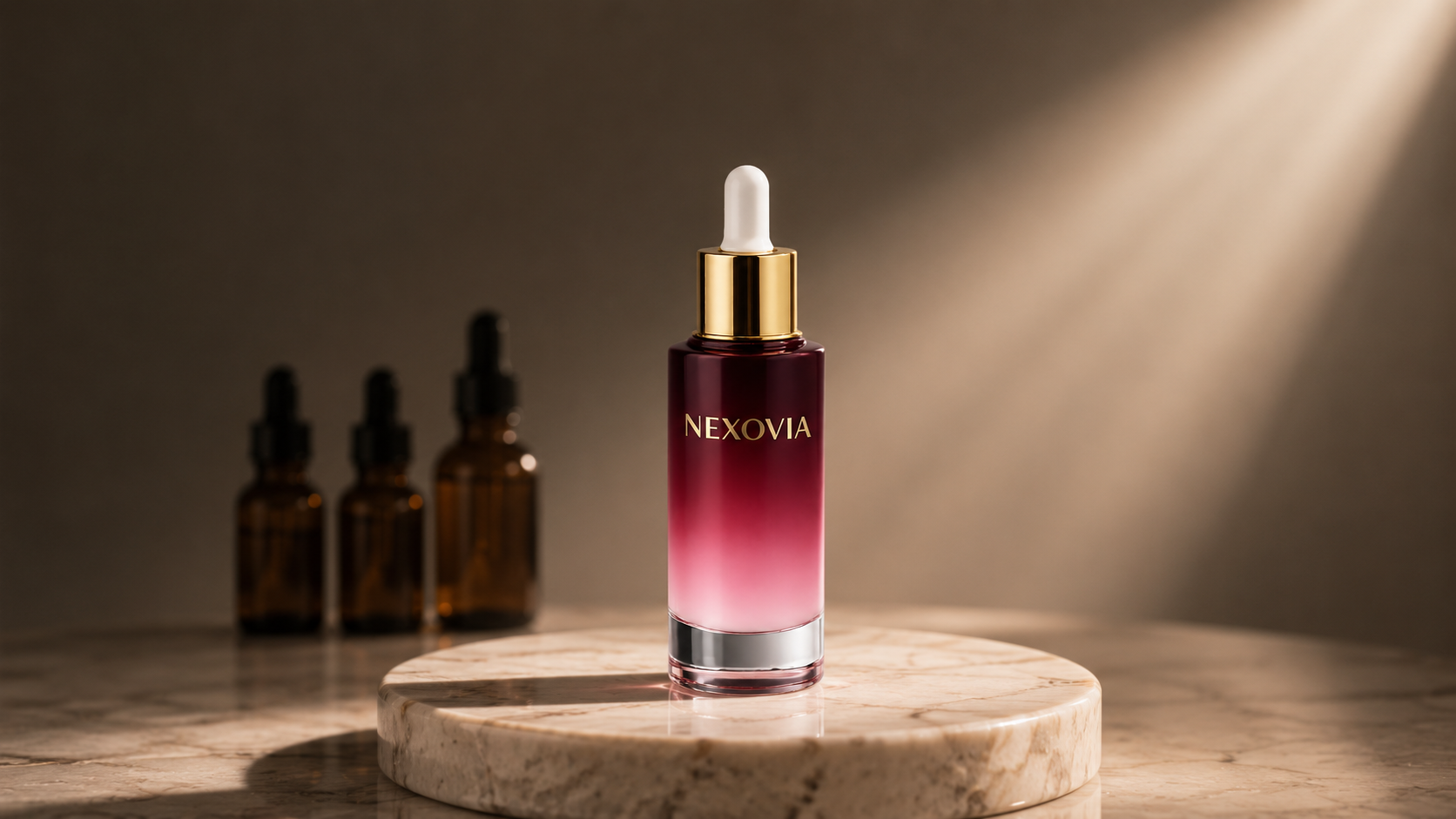
This guide walks through the questions worth asking when evaluating a post-procedure serum, the specific ingredients that justify a place in this category, and how to read a formulation rather than a marketing page.
What a Post-Procedure Serum Actually Needs to Do
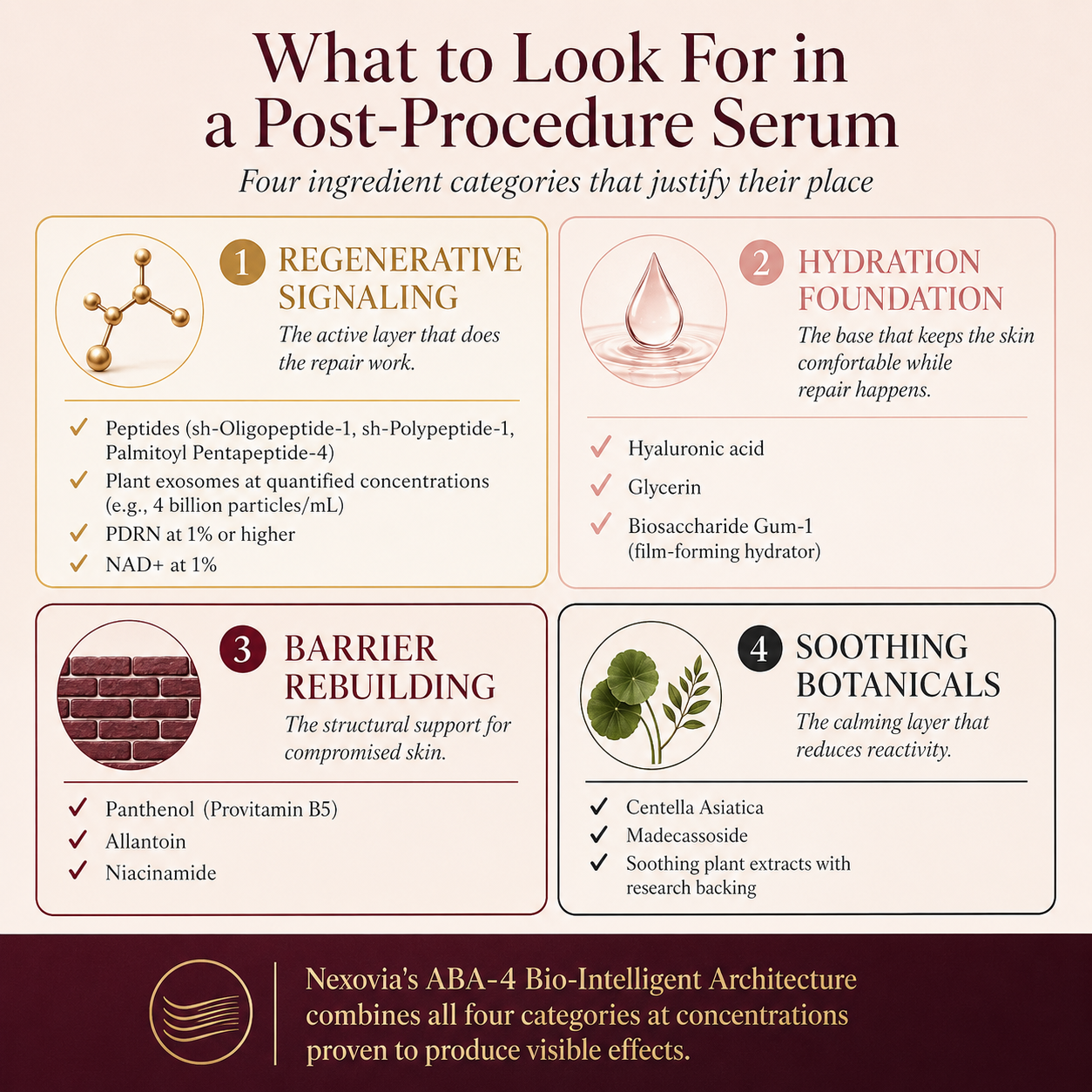
Recovery from an aesthetic procedure involves four parallel processes: hydration restoration, barrier rebuilding, inflammation modulation, and regenerative signaling. A formulation that addresses only one of these is not a post-procedure serum; it is a hydrator with marketing. A formulation that addresses all four is a useful tool.
The four processes are not separable. The skin needs hydration to remain comfortable while it rebuilds. It needs barrier support to retain that hydration. It needs inflammation to be modulated, not eliminated, so repair proceeds without prolonged redness. It needs regenerative signaling to make use of the body's heightened post-procedure activity.
Ingredients That Justify Their Place
Several ingredient categories have evidence supporting their value in post-procedure recovery. Their presence in a formulation is meaningful; their absence raises questions about whether the formulation is engineered for this context at all.
Peptides with documented signaling activity. Specific peptides like sh-Oligopeptide-1 (an EGF mimetic), sh-Polypeptide-1 (FGF mimetic), and matrikines like Palmitoyl Pentapeptide-4 deliver genuine cellular signaling. Their presence at meaningful concentrations indicates a formulation that aims to do regenerative work, not just hydrate.
Plant exosomes. The newer category of intercellular communication carriers. Their inclusion at quantified concentrations (e.g., four billion particles per millilitre) suggests a formulation that takes signaling seriously. Vague mentions of "exosomes" without specification often indicate marketing without substance.
PDRN (polydeoxyribonucleotide). Activates regenerative pathways through adenosine receptors. A meaningful inclusion at one percent or higher indicates a formulation designed for tissue repair, not surface comfort alone.
NAD+. Supplies cellular energy that all of the above signaling demands. Its presence indicates a formulation thinking about the metabolic substrate of repair, not just its triggers.
Hyaluronic acid, glycerin, and other humectants in a balanced base. These are foundational; their absence is disqualifying.
Panthenol, allantoin, and barrier-supporting hydrators. Important for the rebuilding phase.
Soothing botanicals with evidence: Centella Asiatica, Madecassoside, Allantoin, Panthenol. These reduce reactivity without compromising regenerative signaling.
Claims to Discount or Ignore
Several common claims tell you little about the formulation's actual capability.
"Calming" or "soothing" without specified ingredients. Almost any formulation can claim to soothe; what matters is which ingredients produce the effect and at what concentration.
"Doctor formulated" or "dermatologist tested" without specifics. These claims often indicate marketing approval rather than scientific development. The relevant question is what the formulation contains, not who endorses it.
Trademarked ingredient names without underlying chemistry. Brand-name ingredients can be useful when they correspond to specific patented technologies, but a recognizable trademark on the front of the box is not a substitute for understanding what the underlying chemistry does.
"Natural" or "clean" framing for post-procedure use. Recovery skin needs effective ingredients; the "natural" framing often correlates with weaker formulations rather than safer ones.
Promises of dramatic before-and-after results in days. Visible structural recovery takes weeks to months; before-and-after photos in three days are typically of surface flush resolution, which would have happened with any reasonable hydrator.
How to Read an Ingredient List
Ingredient lists are written in descending order of concentration, with one important exception: ingredients at concentrations below 1 percent can be listed in any order. The cutoff is usually somewhere in the middle of the list, often after the preservative.
For a post-procedure formulation, look for the active ingredients (peptides, exosomes, PDRN, NAD+) in the upper third of the list, where they would be at concentrations meaningful enough to produce effects. If they appear near the bottom, after the preservatives and the fragrance, they are present at "claim" concentrations rather than "effect" concentrations.
The base of the formulation, the water, the humectants, the emollients, occupies the top third. This should be a balanced, hydration-focused base for a post-procedure serum, not a heavy occlusive base meant for chronic dryness.
Concentration Versus Architecture
The temptation, when learning what ingredients matter, is to look for the formulation with the highest concentration of the most fashionable ingredient. This is rarely the right approach. The skin's recovery is a multi-process challenge, and a formulation that addresses several processes at meaningful concentrations outperforms one that maximizes a single ingredient.
This is the principle behind the architecture in Nexovia's ABA.4 Bio-Intelligent Architecture. The peptide matrix delivers structural building blocks. Plant exosomes at four billion particles per millilitre coordinate cellular communication. PDRN at one percent activates regenerative pathways. NAD+ at one percent supplies cellular energy. Each component is present at a concentration that produces an effect. The combination addresses the four parallel processes of recovery rather than maximizing a single one.
This is what an effectively formulated post-procedure serum looks like: not the maximum of any one thing, but a coordinated architecture where each component does its work and the combination produces an outcome that no single ingredient could deliver.
Practical Buying Decisions
If you are choosing a post-procedure serum for the first time, start with a formulation that has clearly specified active ingredients at quantified concentrations, contains peptides or exosomes (or both) prominently in the ingredient list, includes barrier-supporting hydration, and has a transparent ingredient list without obscured proprietary blends. The best formulations describe what they contain in specific terms, not in marketing language.
If you are upgrading from a basic formulation, the question to ask is whether the new formulation addresses processes the previous one neglected. Adding regenerative signaling to a routine that only had hydration is a meaningful upgrade. Adding more hydration to a routine that already had it is not.
Frequently Asked Questions
Is a more expensive serum always better?
Not always, but the most effective formulations in the post-procedure category are rarely cheap because the active ingredients (specific peptides, exosomes, PDRN, NAD+) are expensive raw materials. Very inexpensive formulations claiming all of these are usually present at "claim" concentrations rather than effective ones.
Do I need a different serum for each type of procedure?
Generally not. The recovery processes are similar across most aesthetic procedures, even if the depth and timeline differ. A well-formulated post-procedure serum supports recovery across microneedling, laser, peels, and similar treatments.
How much serum should I apply?
For most facial formulations, two to three drops is sufficient for the entire face. Applying more does not produce more effect; the skin can only absorb a finite amount per application. More frequent application of smaller amounts often outperforms heavier single applications.
How long does a bottle typically last?
A 30 ml bottle used twice daily typically lasts six to eight weeks. Bottles that last significantly longer often indicate underuse; the formulation is most effective when applied consistently.
Can I use the same serum for daily routine and post-procedure recovery?
Some formulations are designed for both. The most sophisticated post-procedure serums work as daily anti-aging support between treatments and as more intensive recovery support in the days after. Using a single appropriate formulation simplifies the routine and improves consistency.
This content is for informational purposes only and does not constitute medical advice. Always follow the specific aftercare instructions provided by your practitioner, as recommendations may vary based on your individual treatment and skin type.
Ready to build a more consistent aftercare routine? Explore Nexovia Skin Serum or contact the Nexovia team for more information. Disclaimer: This article is for educational purposes only and is not medical advice. Always follow your provider's guidance after cosmetic procedures.