Journal
The Biggest Aftercare Mistakes That Ruin Your Procedure Results
You researched the procedure, chose your practitioner carefully, paid for the treatment, and endured the discomfort. You did everything right to set yourself up for beautiful...
February 14, 2026 / 11 min read

You researched the procedure, chose your practitioner carefully, paid for the treatment, and endured the discomfort. You did everything right to set yourself up for beautiful results. But the procedure itself is only half the equation. What happens in the days and weeks that follow determines whether you achieve the outcome you envisioned or end up disappointed, dealing with complications, or worse off than before.
Aftercare mistakes are surprisingly common, and they can undo even the most expertly performed procedures. Some errors seem harmless in the moment but have lasting consequences. Others stem from impatience or misunderstanding about what healing skin actually needs.
The good news is that these mistakes are entirely avoidable once you know what they are.
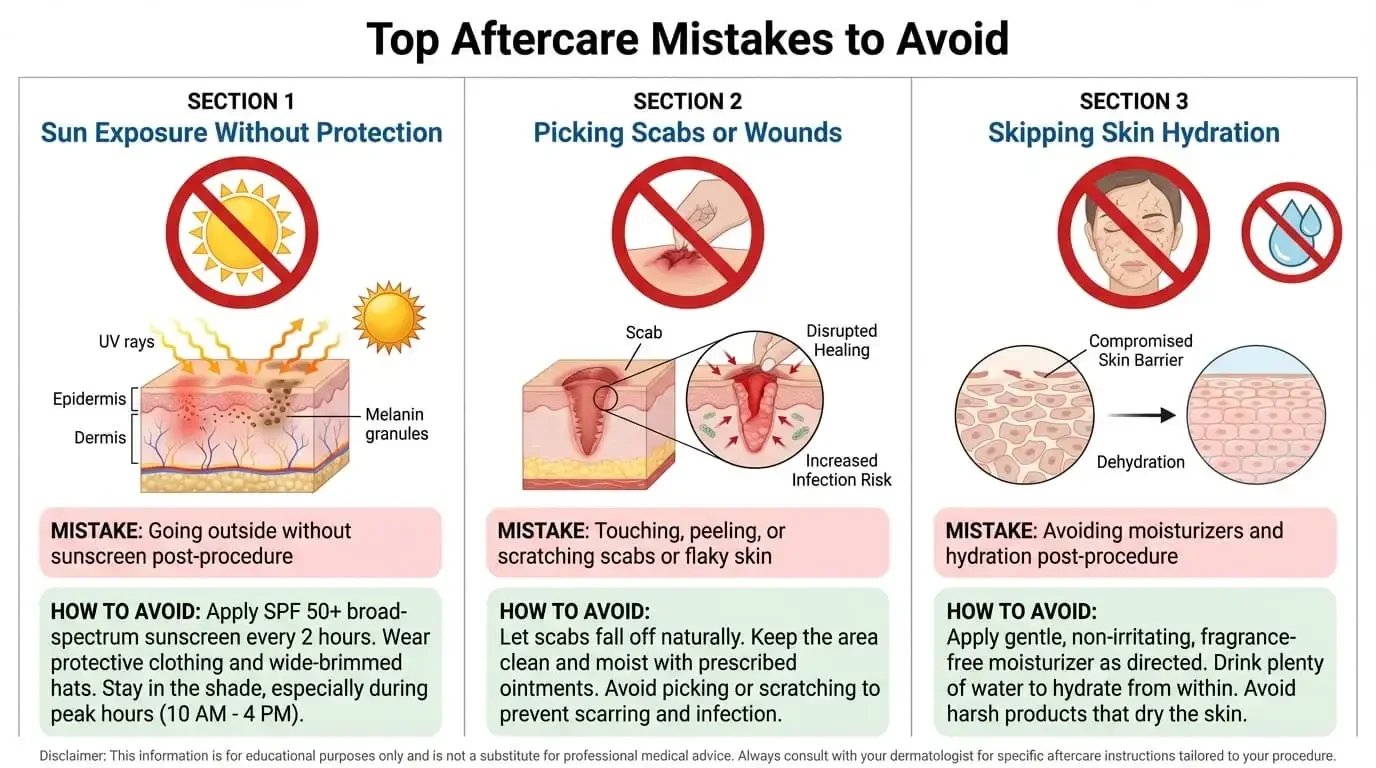
Mistake 1: Unprotected Sun Exposure
This is the single most damaging aftercare mistake, and it is alarmingly common. Patients assume that staying out of direct sunlight or applying their usual SPF 30 is sufficient. It is not.
After aesthetic procedures, your skin is extraordinarily vulnerable to UV damage. The barrier is compromised, new skin lacks protective melanin, and the inflammation present during healing makes your skin more susceptible to pigmentation changes. Sun exposure during this window can cause permanent hyperpigmentation that may be impossible to fully correct.
The damage can occur faster than you expect. Even brief exposure during a quick errand or sitting near a window can be enough to trigger pigmentation problems. UV radiation penetrates clouds and glass, so overcast days and indoor time near windows still pose risks.
How to avoid it: Apply broad-spectrum SPF 50 or higher every single morning during recovery, even if staying indoors. Reapply every two hours if you have any outdoor exposure. Wear wide-brimmed hats when outside. Avoid direct sun entirely during peak hours. Continue this vigilance for at least four to six weeks after your procedure.
Mistake 2: Reintroducing Active Ingredients Too Soon
Your bathroom shelf is full of products you love: your retinol, your glycolic acid toner, your vitamin C serum. Your skin looks healed, so you figure it is time to get back to your routine. This premature reintroduction is one of the fastest ways to derail recovery.
Active ingredients like retinoids, AHAs, BHAs, and vitamin C are beneficial for healthy, intact skin. On healing, barrier-compromised skin, they become irritants that can cause significant inflammation, prolonged redness, increased sensitivity, and damage to delicate new tissue.
Your skin may look recovered on the surface while still being vulnerable beneath. The barrier takes longer to fully restore than visible healing suggests. Introducing actives too early overwhelms skin that is not ready for them.
How to avoid it: Follow the specific waiting periods for each ingredient type. Most practitioners recommend avoiding retinoids for at least seven to fourteen days depending on procedure intensity. AHAs and BHAs require similar waiting periods. When you do reintroduce, start gradually with lower concentrations and reduced frequency. Our retinol reintroduction guide covers exact timelines by procedure type.
Mistake 3: Picking at Peeling or Healing Skin
As your skin heals, you may notice peeling, flaking, or darkened spots that are ready to shed. The temptation to help things along by picking or peeling is almost irresistible. Resist it anyway.
Picking at healing skin causes damage that can result in scarring, infection, or post-inflammatory hyperpigmentation. When you pull at a flake that seems ready to come off, you often tear tissue that is still attached beneath, creating a wound where healing was progressing normally.
The darkened spots that appear after IPL or certain laser treatments are particularly tempting targets. These represent treated pigmentation rising to the surface and must be allowed to shed naturally. Picking them off prematurely can leave permanent marks.
How to avoid it: Keep your hands away from your face except when cleansing or applying products. If peeling edges are bothersome, you can gently trim loose pieces with clean scissors without pulling. Remind yourself that the natural shedding process produces better results than forced removal.
Mistake 4: Using Generic Products Instead of Post-Procedure Formulations
Some patients assume that their regular moisturizer is sufficient for post-procedure care, or they skip products entirely, thinking that leaving skin alone is best. Both approaches leave healing skin without the support it needs.
Post-procedure skin faces specific challenges: barrier compromise, elevated inflammation, increased transepidermal water loss, and intensive repair demands. Generic daily skincare products are not formulated to address these challenges. They may contain fragrances, active ingredients, or other components inappropriate for vulnerable skin.
Using nothing at all forces your skin to heal without support, potentially extending recovery time and compromising results. Your skin needs hydration, barrier support, and ingredients that actively assist the repair process.
Recovery after an aesthetic procedure involves simultaneous biological challenges: inflammation must be modulated, cells need energy to execute repairs, tissue regeneration pathways need activation, and the extracellular matrix needs rebuilding signals. Ingredients like plant exosomes, PDRN, NAD+, and peptides each address different aspects of this process. A formulation that combines them provides coordinated support that no single ingredient or generic moisturizer can match.
How to avoid it: Use products specifically formulated for post-procedure recovery with transparent ingredient concentrations. Apply consistently throughout the recovery period rather than only when skin feels uncomfortable.
Mistake 5: Heat Exposure During Early Recovery
Hot showers feel amazing after a stressful day. The sauna at your gym calls to you. You want to get back to your workout routine. But heat exposure during early recovery intensifies inflammation, increases redness, and can prolong healing time.
Heat causes vasodilation, bringing more blood to your already-flushed skin. This can worsen swelling and redness that would otherwise be subsiding. Sweating introduces salt and bacteria to vulnerable skin, potentially causing irritation or infection. The increased body temperature from exercise or saunas stresses healing tissue.
How to avoid it: Take lukewarm rather than hot showers for at least the first week. Avoid saunas, steam rooms, and hot tubs entirely during recovery. Skip intense exercise for at least 48 to 72 hours, longer for more intensive procedures. When you resume workouts, start with low-intensity activities and monitor your skin's response.
Mistake 6: Applying Makeup Too Soon
You have an event, a meeting, or simply want to feel like yourself again. Covering up post-procedure redness with makeup seems harmless. But applying makeup too early introduces risks that can compromise your results.
During the first 24 hours especially, micro-channels from microneedling or compromised barrier from other procedures create pathways for makeup particles, bacteria, and irritating ingredients to penetrate deeper than they normally would. This can cause infection, breakouts, irritation, or inflammatory reactions.
Even after the first day, makeup requires removal, which means additional cleansing that can stress healing skin. Waterproof or long-wearing formulas are particularly problematic because they require more aggressive removal.
How to avoid it: Wait at least 24 hours before any makeup, longer if your practitioner advises. When you do resume, choose mineral-based, fragrance-free formulas. Use clean applicators. Remove gently with mild cleansers. For more details, see our guide to makeup after microneedling.
Mistake 7: Over-Cleansing or Using Harsh Cleansers
Your skin feels different after a procedure, perhaps oily from healing ointments or textured from peeling. The instinct to cleanse thoroughly is understandable but can backfire significantly.
Foaming cleansers, cleansing brushes, and vigorous scrubbing strip the lipids your skin needs for barrier repair. They irritate sensitive tissue and extend the feeling of tightness and discomfort. Over-cleansing removes not only surface debris but also the beneficial products you have applied.
How to avoid it: Use gentle, non-foaming cleansers with lukewarm water. Cleanse only twice daily unless otherwise directed. Use your fingertips with light pressure rather than cloths or devices. Pat dry rather than rubbing. Apply your aftercare products immediately after cleansing.
Mistake 8: Ignoring Your Practitioner's Instructions
Your practitioner gave you specific aftercare instructions for a reason. They know your treatment parameters, your skin type, and potential concerns specific to your situation. Ignoring their guidance because you read something different online or because the instructions seem overly cautious is a recipe for problems.
Every procedure and every patient is different. Generic advice may not apply to your specific situation. Your practitioner's instructions account for factors you may not be aware of.
How to avoid it: Follow your practitioner's specific aftercare instructions even if they differ from general guidance. If you have questions or concerns, contact their office rather than making assumptions. Keep their instructions accessible and refer to them throughout recovery.
Mistake 9: Expecting Instant Results and Abandoning Aftercare Early
Results from aesthetic procedures develop over time. Collagen remodeling continues for months. Pigmentation fades gradually. The full benefits may not be apparent for weeks or even months after treatment.
Some patients become discouraged when they do not see immediate dramatic improvement and abandon their aftercare routine prematurely. Others assume that once visible healing completes, aftercare is no longer necessary. Both approaches can compromise final results.
The procedures you invest in trigger biological processes that unfold over an extended timeline. Microneedling results continue developing for up to three months. Laser resurfacing collagen remodeling can continue for six months. Supporting these processes throughout their duration, not just during the visible healing phase, maximizes your return on the investment you made.
How to avoid it: Set realistic expectations about your results timeline. Understand that visible recovery and complete healing are different things. Continue your aftercare routine for the full recommended duration. Trust the process and give your skin time to reveal the full benefits of your treatment.
How Proper Aftercare Prevents All Nine Mistakes
The common thread in many of these mistakes is using inappropriate products, the wrong products, or no dedicated products at all. A structured aftercare approach with purpose-built formulations addresses multiple potential errors simultaneously.
The right aftercare product should be formulated for compromised, post-procedure skin, meaning no fragrances, no harsh actives, no irritants. It should support barrier repair at the cellular level rather than just masking symptoms. It should modulate inflammation rather than ignoring it. And it should provide the cellular energy and signaling that accelerated healing demands.
This is why multi-technology formulations outperform single-ingredient approaches for aftercare. Your skin is not dealing with one challenge after a procedure. It is dealing with barrier compromise, inflammation, energy depletion, and matrix damage simultaneously. A product that addresses all of these through complementary mechanisms, like plant exosomes for cellular communication, PDRN for tissue regeneration, NAD+ for cellular energy, and peptides for structural rebuilding, turns the recovery period into an opportunity for your skin rather than a vulnerable window.
Nexovia Skin Serum was formulated on exactly this principle. The ABA.4 Bio-Intelligent Architecture combines plant exosomes at 4 billion particles per milliliter, PDRN at 1%, NAD+ at 1%, and a peptide matrix with EGF-mimetics and matrikines. Made in South Korea and developed specifically for post-procedure recovery, it is designed to protect the investment you made in your procedure by supporting every phase of healing.
Frequently Asked Questions
What is the single most important aftercare step?
Sun protection. While all aspects of aftercare matter, no other single mistake has the potential to cause permanent damage as quickly as unprotected sun exposure during recovery. Apply SPF 50 daily without exception throughout your recovery period, and maintain strict sun protection for at least four to six weeks.
How do I know if I have made an aftercare mistake?
Signs that something has gone wrong include worsening redness after the first few days, increasing pain, signs of infection like pus or fever, unusual darkening of the skin, or intense irritation that is not improving. If you experience any concerning symptoms, contact your practitioner promptly rather than trying to self-treat.
Can aftercare mistakes be corrected?
Many aftercare mistakes can be recovered from if caught early. Stop whatever caused the problem, return to gentle supportive care with barrier-repairing ingredients like plant exosomes and PDRN, and contact your practitioner if needed. Some consequences, like hyperpigmentation from sun exposure, may require additional treatment to correct. Prevention is always preferable to correction.
Is it better to do too little or too much with aftercare?
A gentle, consistent approach with purpose-built products is better than either extreme. Doing nothing leaves your skin without support. Doing too much with aggressive products or frequent product changes can overwhelm healing skin. The ideal is a structured routine using a multi-technology aftercare formulation applied consistently at recommended frequencies, combined with strict sun protection and avoidance of irritants.
This content is for informational purposes only and does not constitute medical advice. Always follow the specific aftercare instructions provided by your practitioner, as recommendations may vary based on your individual treatment and skin type.


