Journal
Is It Safe to Use Active Ingredients Between Procedure Sessions
Between aesthetic sessions, active ingredients can help or hinder. Here is how to decide which to use, when to pause them, and what to leave alone.
September 8, 2026 / 6 min read
Between aesthetic sessions, the routine question is not whether to use active ingredients, but how. Patients receiving microneedling, laser, or peel series typically do not need to abandon the actives that have been part of their routine for years. They do need to time them differently, calibrate concentrations, and recognize when restraint is the right answer.
This article explains the principles for using actives between sessions, the categories of active that require the most thoughtfulness, and how to plan a routine that supports rather than undermines your treatment series.
The Underlying Principle: Timing Around the Procedure
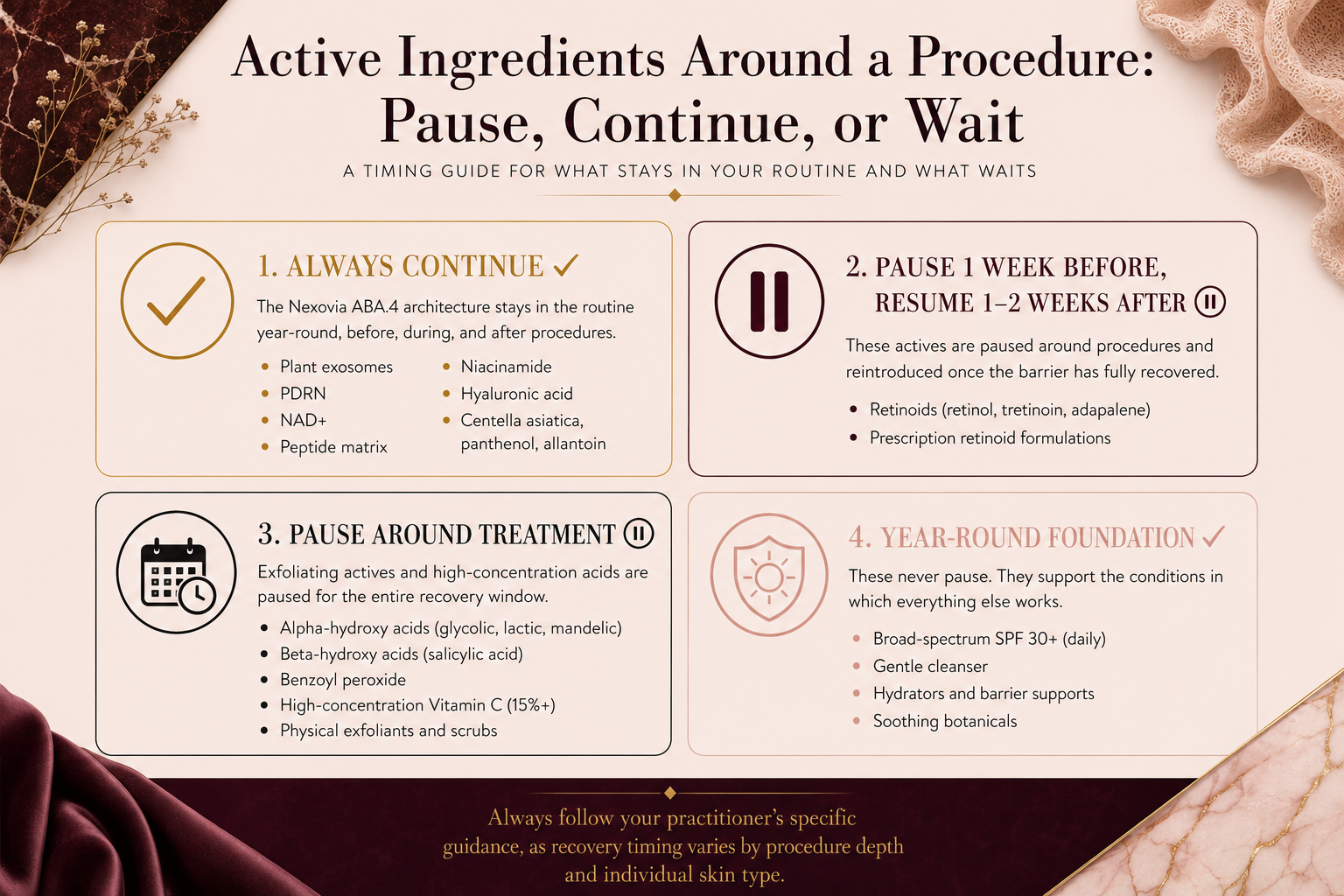
The basic principle is straightforward: in the immediate days before and after a session, actives are paused. Outside of that window, the routine returns to its normal configuration. The question is how wide that window should be, and the answer depends on the specific procedure and the specific active.
For most non-ablative procedures, a one-week pre-treatment pause and a one- to two-week post-treatment pause is the typical window. For deeper procedures, the windows extend; for very superficial treatments like dermaplaning, they may shorten to a few days on either side.
Retinoids: The Most Important to Manage
Retinoids are both the most effective long-term anti-aging active and the most likely to interfere with procedure recovery. They accelerate cellular turnover, increase TEWL, and produce mild inflammation as part of their mechanism. After a procedure, all three properties are counterproductive.
The general protocol is to discontinue retinoids one week before a treatment and resume one to two weeks after, depending on procedure depth. Specific timelines for retinol reintroduction vary by treatment type. Patients on prescription tretinoin sometimes pause for longer to ensure full barrier recovery before resuming.
Between sessions, retinoids return to their normal frequency. Most users tolerate two to three nights per week of retinol. More aggressive nightly use is sustainable for some, but not necessary for most of the benefit.
Alpha-Hydroxy Acids and Beta-Hydroxy Acids
Glycolic acid, lactic acid, mandelic acid, and salicylic acid all exfoliate the skin chemically. Like retinoids, they increase TEWL and can produce mild irritation. The peri-procedure pause for AHAs and BHAs is typically the same as for retinoids: one week before and one to two weeks after.
Between sessions, the use of acids depends on the type of treatment series. If your series includes chemical peels, the regular use of acids in your home routine often becomes redundant or counterproductive; the in-clinic peels deliver more controlled exfoliation than the home routine can. If your series is microneedling-based, mild home exfoliation can complement the treatment as long as it is timed away from the appointments.
Vitamin C
Vitamin C in topical formulations is one of the most useful long-term antioxidants. The peri-procedure consideration is concentration. Low-concentration, well-formulated vitamin C is generally well tolerated within a few days of a procedure. High-concentration formulations, particularly those with a low pH, are typically paused for the same window as retinoids.
Between sessions, vitamin C resumes at the patient's usual concentration. It pairs well with sunscreen during the morning routine and provides antioxidant defense that is particularly valuable around treatment series, where oxidative stress is elevated.
Niacinamide and Peptides: The Permissive Category
Niacinamide and peptides occupy a different category. Both have minimal irritation potential, work through signaling rather than mechanical or chemical exfoliation, and are generally compatible with both immediate post-procedure use and long-term routine use.
Niacinamide can typically be used immediately after a procedure as long as the formulation is well tolerated. Peptides are similarly compatible. These two categories form the backbone of a permissive between-session routine: they support the work the procedure has done without competing with it.
What Stays in the Routine Year-Round
Some categories of skincare do not pause for procedures. Sunscreen, gentle cleansers, hydrators, ceramide-rich barrier supports, and soothing botanicals like centella asiatica are appropriate before, during, and after treatment series. They do not interfere with the work of the procedure; they support the conditions in which the procedure does its best work.
The discipline of maintaining these continuously, while pulling back actives at the right moments, is the framework that produces the most consistent results over a treatment series.
Why Architecture Matters Between Sessions
The temptation between sessions is to maximise: more actives, more frequently, on the assumption that aggression compounds with the treatment. The opposite is usually true. The treatment provides the dramatic intervention; the between-sessions routine should support consolidation rather than add additional stress.
Nexovia's ABA.4 Bio-Intelligent Architecture is built for this consolidation phase. The peptide matrix supports continued structural rebuilding. Plant exosomes at four billion particles per millilitre extend the cellular communication that the treatment initiated. PDRN at one percent activates regenerative pathways without the irritation profile of mechanical actives. NAD+ at one percent fuels the cellular activity that consolidation requires. The combination delivers repair signaling without competing with the actives that you reintroduce as the recovery window closes.
Frequently Asked Questions
How do I know my skin is ready to resume actives after a procedure?
The skin should feel normal, not tight, not sensitive to touch, with no visible flaking or unusual texture. If you have to ask whether it is ready, it usually is not. When in doubt, wait an additional three days.
Can I use vitamin C and retinol on the same nights?
It is more common to alternate them, with vitamin C in the morning and retinol in the evening. Some patients use both at night without issue, others find it irritating. The simplest, most tolerated routine usually outperforms the most aggressive one over the long term.
Should I do an at-home peel between professional treatments?
Generally not. The professional treatments deliver more controlled, more effective exfoliation than home peels. Adding home peels often produces redundancy and increases the risk of barrier compromise.
What about exfoliating face masks?
Treat them like acids. Pause around the procedure window. Use sparingly between sessions. Be skeptical of any mask claiming dramatic immediate results; the most useful masks tend to hydrate rather than exfoliate.
If I am on prescription retinoids, do I need different timelines?
Often yes. Prescription retinoids have stronger effects on the barrier than over-the-counter formulations. Discuss specific timing with your practitioner, as some recommend longer pauses around procedures.
This content is for informational purposes only and does not constitute medical advice. Always follow the specific aftercare instructions provided by your practitioner, as recommendations may vary based on your individual treatment and skin type.
Disclaimer: This article is for educational purposes only and is not medical advice. Always follow your provider's guidance after cosmetic procedures.