Journal
When Can I Use Retinol Again After Microneedling or Laser?
Retinol has earned its place as the gold standard in anti-aging skincare. You have spent months building tolerance, finally reaching a point where your skin accepts it without...
February 24, 2026 / 9 min read

Retinol has earned its place as the gold standard in anti-aging skincare. You have spent months building tolerance, finally reaching a point where your skin accepts it without irritation, and now you are seeing the results you worked for. Then you had a procedure, and your practitioner told you to stop using retinol. It has been a week, your skin looks healed, and you are itching to get back to your routine.
When is it actually safe to reintroduce retinol after microneedling or laser treatment? Too soon, and you risk irritation, prolonged redness, or damage to your healing skin. Too cautious, and you unnecessarily extend your time away from an ingredient you value.
This guide provides clear timelines for safely reintroducing retinol after various procedures, explains why the waiting period matters, and offers guidance on what to use in the meantime so the recovery period is not wasted time for your skin.
Why Retinol Must Be Avoided After Procedures
Retinol and other retinoids work by accelerating cellular turnover and influencing gene expression in skin cells. These mechanisms deliver powerful anti-aging benefits: increased collagen production, faster cell renewal, improved texture, and reduced hyperpigmentation. However, these same mechanisms create problems for barrier-compromised skin.
After aesthetic procedures, your skin barrier is already disrupted. The treatment created controlled injury that your skin is working to repair. Adding retinol during this vulnerable period introduces additional stress that can overwhelm your healing capacity.
Retinoids increase cell turnover at a time when your skin is already shedding damaged cells and producing new ones as part of the healing process. This accelerated turnover can become excessive, leading to irritation, peeling, and prolonged sensitivity. The exfoliating effect of retinoids, beneficial on intact skin, becomes problematic when applied to an already-compromised barrier.
Retinoids can also increase inflammation in healing skin. While some inflammation is necessary for the healing cascade, excessive or prolonged inflammation impairs recovery and increases the risk of complications like post-inflammatory hyperpigmentation. The irritation potential of retinoids on sensitized skin far exceeds what you experience with your normal, adapted skin.
The barrier disruption caused by procedures also means that retinol penetrates more deeply than usual. Ingredients that your tolerant skin handles easily can cause significant reactions when they access deeper layers through a compromised barrier.
Retinol Reintroduction Timelines by Procedure
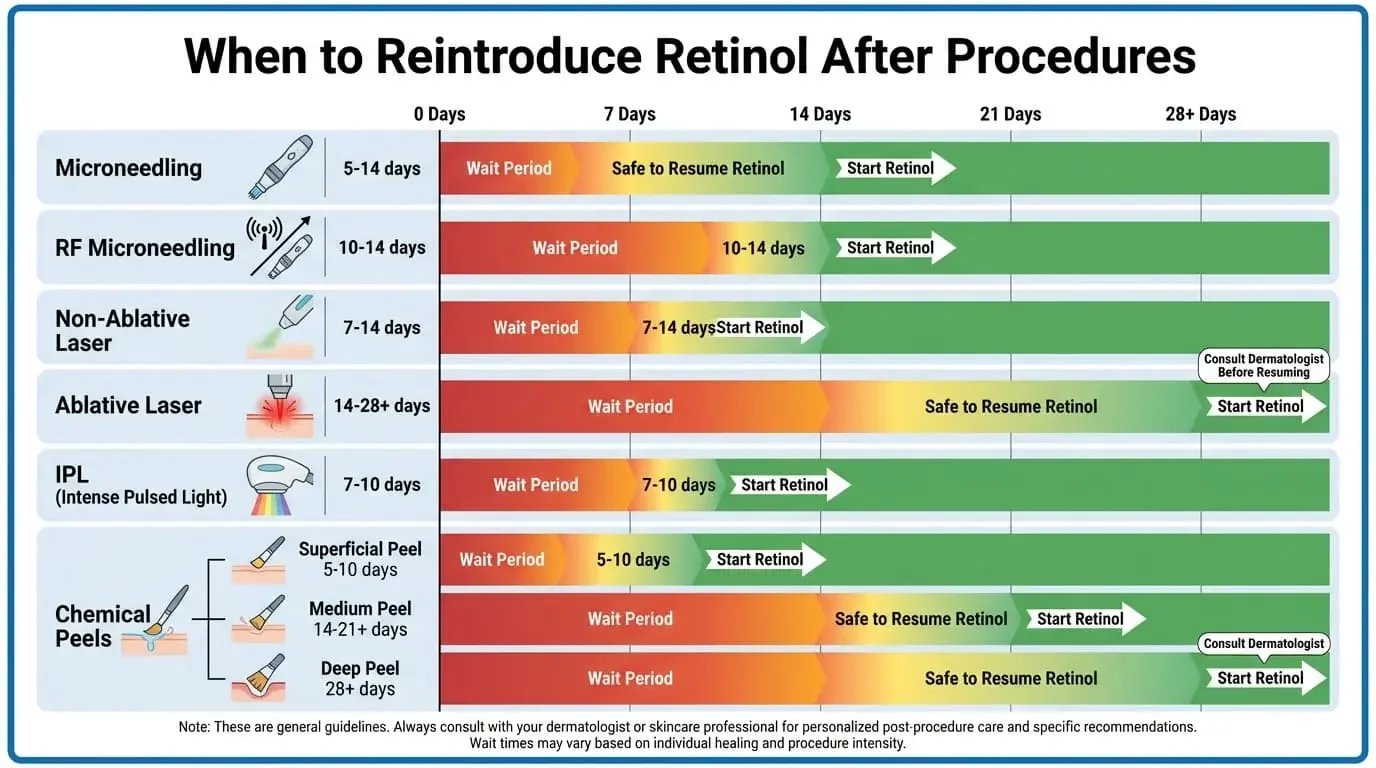
The appropriate waiting period depends on the procedure type and intensity. More aggressive treatments require longer retinol-free periods. These are general guidelines; always defer to your practitioner's specific instructions.
After Microneedling
For superficial microneedling with shorter needle depths, most practitioners recommend avoiding retinol for at least five to seven days. Your barrier typically recovers sufficiently within this window to tolerate gentle retinoid reintroduction. For deeper microneedling targeting acne scars or more significant concerns, extend the waiting period to ten to fourteen days. Read our complete microneedling aftercare guide for the full recovery timeline.
After RF Microneedling
RF microneedling combines mechanical injury with thermal energy, creating more significant disruption than traditional microneedling. Wait at least ten to fourteen days before reintroducing retinol. Some practitioners recommend a full two weeks to ensure the thermal effects have fully resolved. See our RF vs traditional microneedling recovery comparison for a detailed breakdown.
After Non-Ablative Laser Treatments
Non-ablative lasers heat the dermis without removing surface skin, but they still affect barrier function and cause inflammation. Wait at least seven to ten days for lighter treatments. More intensive non-ablative procedures may require two weeks before retinol reintroduction.
After Ablative Laser Treatments
Ablative lasers like CO2 and Erbium remove the outer skin layers, creating the most significant barrier disruption. Wait a minimum of two to four weeks, and follow your practitioner's specific guidance. Some practitioners recommend waiting even longer, particularly for more aggressive treatment parameters. Our laser resurfacing aftercare guide covers the full recovery timeline.
After IPL
IPL creates thermal injury to targeted chromophores without significant surface disruption. Most patients can reintroduce retinol after seven to ten days, once redness and sensitivity have resolved and any treated pigmentation has flaked away. See our IPL aftercare guide for the complete recovery timeline.
After Chemical Peels
Timing depends on peel depth. Superficial peels may allow retinol reintroduction after five to seven days. Medium-depth peels typically require two weeks. Deep peels require the longest waiting period, often four weeks or longer, and you should follow your physician's specific guidance. Our chemical peel aftercare guide has detailed timelines by peel depth.
How to Tell If Your Skin Is Actually Ready
Beyond following general timelines, assess your skin's actual condition before reintroducing retinol. Timelines are estimates. Your skin's readiness is the true indicator.
No visible redness from the procedure should remain. Any pinkness should have fully resolved. If you still see treatment-related discoloration, your skin is not ready.
Touch your skin gently. It should feel comfortable, not tight or sensitive. If your skin still feels reactive to touch or temperature changes, wait longer.
Your skin should tolerate your normal gentle products without any stinging or discomfort. If your basic cleanser or moisturizer still causes sensitivity, retinol will cause problems.
Any peeling or flaking from the procedure should be completely resolved. New skin should appear healthy and stable, not fragile or compromised.
When in doubt, wait a few extra days. There is no benefit to rushing retinol reintroduction, and the risk of setback from premature use outweighs any advantage of returning a few days earlier.
How to Safely Reintroduce Retinol
Even when your skin is ready, smart reintroduction minimizes irritation risk.
Start Lower Than Your Previous Strength
If you were using a high-strength retinol or prescription retinoid before your procedure, step down to a gentler formulation for the first week or two. Your skin's tolerance has decreased during the break. Rebuilding gradually prevents unnecessary irritation.
Reduce Frequency Initially
If you previously used retinol nightly, start with every third night for the first week, then every other night, then return to nightly use if tolerated. This graduated approach allows your skin to readapt without overwhelming it.
Buffer With Moisturizer
Applying moisturizer before retinol, known as buffering, reduces penetration and irritation potential. Consider buffering for the first few applications, then transition to applying retinol to bare skin once tolerance is confirmed.
Monitor Carefully
Pay close attention to how your skin responds. Mild adjustment effects like slight dryness or minor flaking may be normal. Significant redness, burning, or intense peeling indicates you reintroduced too aggressively. If irritation occurs, pause retinol and allow skin to recover before trying again more gradually.
What to Use Instead of Retinol During Recovery
The retinol-free recovery period does not mean abandoning your skin improvement goals. Several ingredients provide complementary anti-aging and regenerative benefits without the irritation risk, and some actively accelerate your recovery at the same time.
- Peptides signal collagen production and support skin repair through mechanisms entirely different from retinoids. EGF-mimetics promote cellular renewal. Matrikines stimulate extracellular matrix production. These benefits overlap with retinol's goals without the barrier stress.
- PDRN activates tissue regeneration pathways through adenosine A2A receptor signaling and supports collagen synthesis. It provides regenerative benefits while actively supporting the healing process rather than stressing it.
- NAD+ fuels cellular energy and supports DNA repair via PARPs and sirtuin activation, providing anti-aging benefits at the cellular level that retinol cannot access.
- Plant exosomes coordinate cellular communication and modulate inflammation while delivering bioactive compounds that support both healing and rejuvenation.
- Niacinamide offers barrier support, brightening, and pore refinement without any irritation potential.
These ingredients allow you to continue supporting your skin during the retinol-free period, rather than simply waiting passively for healing to complete. The recovery window becomes productive time for your skin rather than a gap in your routine.
Making the Recovery Period Work for Your Skin
The best approach to the retinol-free window is using it as an opportunity rather than viewing it as downtime. Products that combine multiple recovery and anti-aging technologies allow you to support healing while continuing to pursue the same goals retinol serves: collagen production, cellular renewal, and skin quality improvement.
Nexovia Skin Serum was built for exactly this situation. The ABA.4 Bio-Intelligent Architecture combines plant exosomes at 4 billion particles per milliliter, PDRN at 1%, NAD+ at 1%, and a peptide matrix with EGF-mimetics and matrikines. Together, these technologies support collagen synthesis, cellular renewal, and skin matrix rebuilding through pathways that complement healing rather than competing with it.
For retinol users, the post-procedure period does not need to be a setback. It can be the phase where your skin receives the deepest level of regenerative support it has ever had.
Frequently Asked Questions
Will I lose my retinol tolerance during the break?
Some tolerance decrease is likely during an extended break, which is why gradual reintroduction is recommended. However, rebuilding tolerance after a two-week break is much faster than building it initially. Most people return to their previous routine within two to three weeks of restarting.
Can I use retinol the night before a procedure?
Most practitioners recommend stopping retinol at least three to seven days before procedures, not just after. Retinol thins the outer skin layers and increases sensitivity, which can affect treatment outcomes and recovery. Check with your practitioner for specific pre-procedure instructions.
Does the waiting period apply to prescription retinoids like tretinoin?
Yes, and prescription retinoids typically require the longer end of recommended waiting periods due to their higher potency. Tretinoin is more irritating than over-the-counter retinol, so extra caution is warranted. Follow your prescribing physician's guidance on when to resume.
What if I accidentally used retinol too soon?
Stop using it immediately. Apply soothing, hydrating products to calm your skin. Ingredients like hyaluronic acid, Centella Asiatica, and niacinamide can help reduce irritation. Avoid all other active ingredients until irritation resolves. The setback is usually temporary, but you will need to wait for your skin to recover before attempting reintroduction again. A multi-technology recovery serum with plant exosomes and PDRN can help accelerate the calming process.
What is the best serum to use instead of retinol during recovery?
Look for a formulation that addresses collagen production, cellular energy, and skin renewal through non-irritating mechanisms. Ingredients like plant exosomes, PDRN, NAD+, and peptides provide overlapping benefits with retinol through entirely different pathways, making them ideal for the recovery period. Nexovia Skin Serum combines all four in a single formulation designed specifically for post-procedure skin, so the retinol-free window becomes a period of intensive regenerative support rather than a gap in your routine. Take the Skin Recovery Assessment
This content is for informational purposes only and does not constitute medical advice. Always follow the specific aftercare instructions provided by your practitioner, as recommendations may vary based on your individual treatment and skin type.


