Journal
Biosaccharide Gum-1 Explained: The Hidden Hero of Sensitive Skincare
Biosaccharide Gum-1 quietly does the work that keeps reactive, post-procedure skin comfortable. Here is what it is and why it deserves a place in your routine.
August 20, 2026 / 6 min read
Among the ingredients that quietly carry sensitive skincare, Biosaccharide Gum-1 is one of the least discussed and most useful. It does not promise transformation, it does not dazzle on a label. What it offers is consistency: lasting hydration, reduced reactivity, and a smoother feel on skin that has been compromised by treatment, environment, or over-zealous routines.

For post-procedure skin in particular, where actives are off the table and the barrier is in active repair, this ingredient does important work without asking the skin to react to it. This piece explains what Biosaccharide Gum-1 is, what it actually does in a formula, and where it fits within a calm, considered routine.
What Biosaccharide Gum-1 Actually Is
Biosaccharide Gum-1 is a polysaccharide derived from the bacterial fermentation of plant sugars. In simpler terms, it is a sugar-based film-forming hydrator created through a controlled biotechnological process. It belongs to a family of ingredients that hold large amounts of water relative to their molecular size, which is the foundation of their value to skin.
What distinguishes it from other humectants is its molecular architecture. The molecule is large enough to remain on the surface of the skin where it forms a thin, breathable film, yet flexible enough to follow the contours of the skin without producing tightness or stiffness. This balance is unusual; many film formers feel occlusive, while many humectants offer no surface effect at all.
How It Behaves on Compromised Skin
Compromised skin, whether from a recent procedure, environmental aggression, or over-exfoliation, behaves predictably: barrier function is reduced, water loss accelerates, and nerve receptors become more reactive to ordinary stimuli. The skin feels tight, looks dull, and tolerates fewer ingredients than usual.
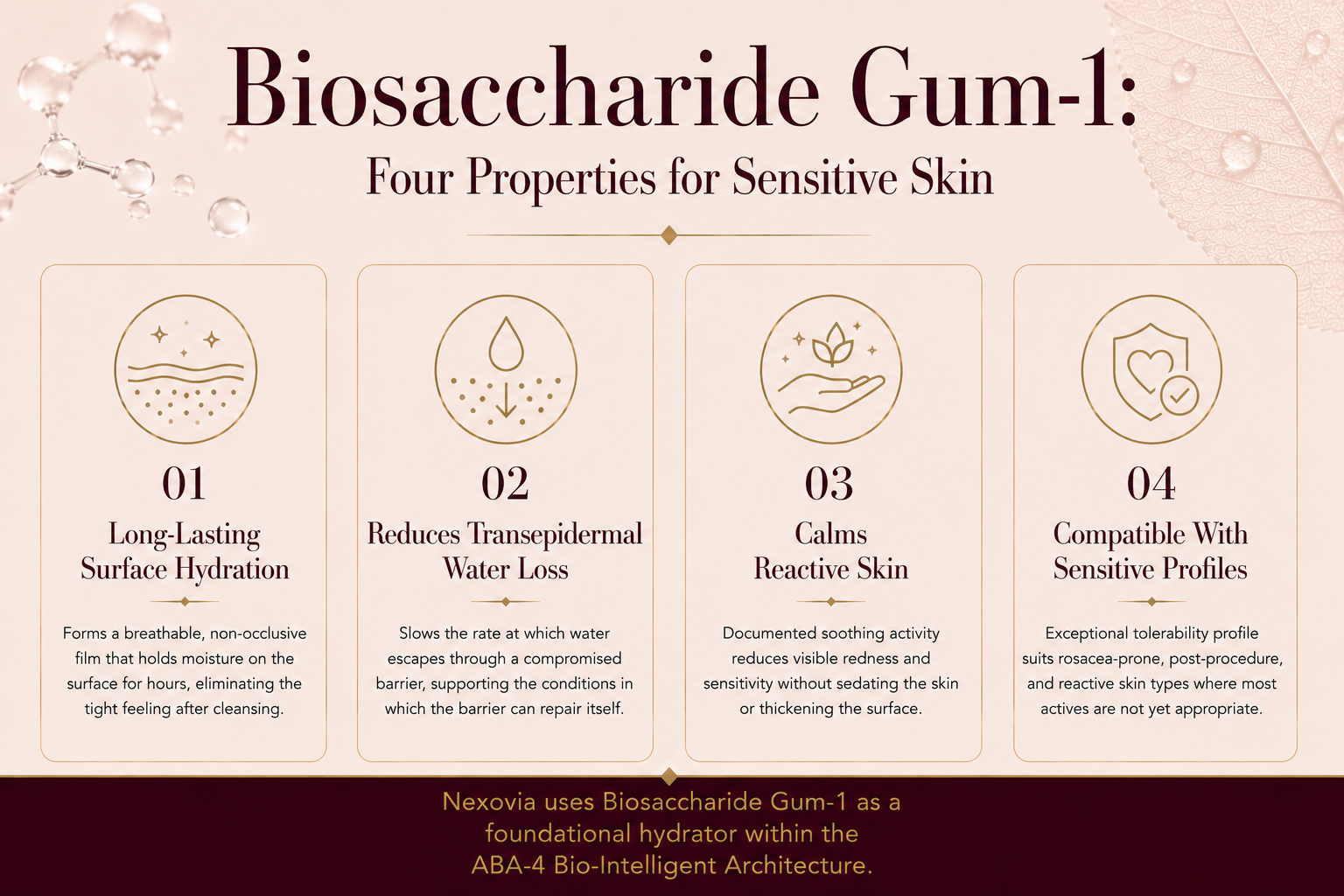
Biosaccharide Gum-1 addresses several of these issues simultaneously. By forming a hydrated film over the surface, it slows the rate of water leaving the skin, reducing the sensation of tightness within minutes of application. The film is non-occlusive, meaning it does not trap heat or interfere with the natural exchange that the skin requires to function. Over consistent use, the surface becomes more even, and the small lines that exaggerate when skin is dehydrated visibly soften.
Equally important is what the ingredient does not do. It does not stimulate. It does not exfoliate. It does not interact aggressively with other actives. For skin that has been pushed too far, this absence of demand is the most valuable property an ingredient can offer.
Where It Sits in the Hydration Hierarchy
It helps to place Biosaccharide Gum-1 within the wider category of hydrating ingredients to understand its role. Hyaluronic acid draws moisture into the skin from the surrounding environment and from deeper tissue. Glycerin, a smaller humectant, integrates with the skin's natural moisture factors. Panthenol and allantoin support the rebuilding of the lipid matrix between cells.
Biosaccharide Gum-1 sits adjacent to all three. It is most often used as a co-hydrator alongside hyaluronic acid, where its film-forming behaviour locks in the moisture that hyaluronic acid attracts. Without a film former, the moisture that humectants pull to the surface can also evaporate from the surface; the gum slows that loss meaningfully.
Sensitivity, Reactivity, and the Quiet Work of Soothing
Beyond hydration, Biosaccharide Gum-1 has documented soothing behaviour. Studies on the ingredient describe a measurable reduction in markers of skin reactivity when it is applied to skin previously challenged by surfactants or other irritants. The mechanism is partly mechanical, the protective film, and partly biochemical, with evidence that the ingredient interacts with surface receptors in a way that calms the skin's signaling.
This makes it an unusually appropriate ingredient for the days after a procedure. The body's healing response naturally heightens reactivity, which is why ordinary products can feel uncomfortable in this period. An ingredient that genuinely calms the surface without sedating it, without thickening the skin or trapping heat, is rare. Biosaccharide Gum-1 is one of the few that achieves this combination.
Why It Works Best Within a Layered Architecture
Sensitive and recovering skin does not benefit from single-ingredient formulations. It benefits from architectures, where each component plays a specific role and the combination produces an outcome that no single ingredient could deliver alone. Biosaccharide Gum-1 functions as a connective tissue across such formulations.
Within Nexovia's ABA.4 Bio-Intelligent Architecture, hydration and surface comfort are not isolated outcomes but the substrate on which everything else operates. Plant exosomes at four billion particles per millilitre coordinate cellular communication. PDRN at one percent supports the regeneration pathways that follow controlled injury. NAD+ at one percent fuels the cellular activity those signals require. The peptide matrix delivers the structural building blocks for repair. None of these ingredients function optimally on a dehydrated, reactive surface; the soothing and hydrating layer is what allows the regenerative work to proceed undisturbed.
This is the role Biosaccharide Gum-1 plays in a comprehensive recovery formula: not the headline, but the medium through which the headline acts. Skin that is comfortable accepts active ingredients better, retains moisture longer, and shows the results of treatment more clearly. Peptides and exosomes deliver more when the surface is calm.
How to Recognise It in a Formula
On an ingredient list, look for "Biosaccharide Gum-1" in the upper third of the formulation, where it appears as a hydrating agent. It is often paired with sodium hyaluronate, glycerin, or pentylene glycol. Its presence in a serum suggests the formulator has thought beyond simple humectancy and considered the wearing experience of the product on reactive skin.
Concentration is generally between 0.1 and 1 percent, which is enough for full effect; this is not an ingredient that benefits from being maximised. Quality of pairing matters more than concentration alone.
Frequently Asked Questions
Is Biosaccharide Gum-1 safe for very reactive or rosacea-prone skin?
It is generally well tolerated by reactive skin types, including rosacea-prone and atopic skin. Its low irritation profile and absence of stimulation make it one of the more reliable hydrators for compromised barriers. As always, patch testing a new product is sensible.
Does it cause buildup or pilling?
At appropriate concentrations within a balanced formulation, it does not cause pilling. Pilling is more often a function of how products are layered, particularly when oil-rich and silicone-rich textures are applied close together. Allow each layer to absorb fully before applying the next.
Can it replace hyaluronic acid in a routine?
The two ingredients work differently and ideally appear together. Hyaluronic acid attracts moisture; Biosaccharide Gum-1 helps retain it on the surface. Replacing one with the other gives less complete hydration than using both.
How quickly do results appear?
Surface comfort is typically noticeable within minutes of application, particularly the reduction in tightness. Visible improvements in surface evenness develop over two to four weeks of consistent use.
Is it appropriate immediately after a procedure?
It is one of the most appropriate ingredients for immediate post-procedure use, alongside other low-irritant hydrators. Always follow your practitioner's specific guidance, but this category of ingredient is generally introduced from day zero or one of recovery.
This content is for informational purposes only and does not constitute medical advice. Always follow the specific aftercare instructions provided by your practitioner, as recommendations may vary based on your individual treatment and skin type.
Disclaimer: This article is for educational purposes only and is not medical advice. Always follow your provider's guidance after cosmetic procedures.