Journal
K-Beauty Aftercare: Why Korean Skincare Leads in Post-Procedure Recovery
When your skin is healing after microneedling, laser treatment, or a chemical peel, the products you use during recovery directly shape your final results. And increasingly,...
February 12, 2026 / 8 min read

When your skin is healing after microneedling, laser treatment, or a chemical peel, the products you use during recovery directly shape your final results. And increasingly, the most advanced aftercare formulations are coming from one place: South Korea.
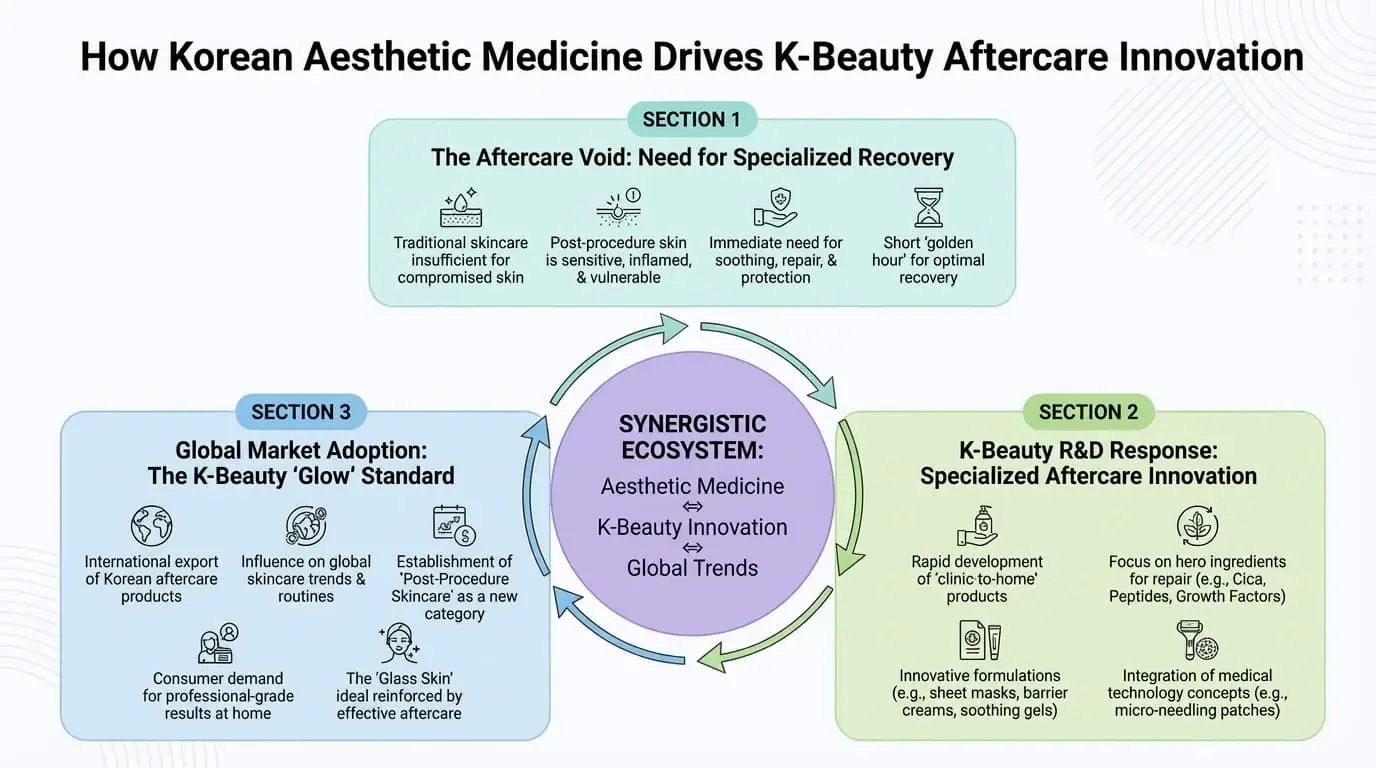
This is not a coincidence. Korea's dominance in post-procedure skincare is the result of a unique ecosystem where aesthetic medicine, ingredient science, consumer demand, and manufacturing expertise converge to produce formulations that simply do not exist elsewhere.
Here is why Korean aftercare leads the world, what makes it different, and what to look for when choosing products for your own recovery.
The Korean Skincare Philosophy: Healing Over Correcting
Western skincare culture has traditionally emphasized correction: fix acne, reverse wrinkles, fade spots. Korean skincare starts from a fundamentally different premise. The goal is to maintain barrier health, support the skin's own repair processes, and prevent problems before they start.
This philosophy translates directly into how Korean brands approach aftercare. Rather than overloading compromised skin with aggressive actives, Korean post-procedure formulations focus on providing the raw materials and signaling molecules your skin needs to repair itself. Hydration, inflammation modulation, cellular energy, and matrix rebuilding come first. Active ingredients like retinoids and acids are reintroduced only after the barrier has recovered.
For post-procedure skin, this approach is not just preferable. It is clinically sound. A compromised barrier requires support, not stimulation. Korean formulations are built around this principle.
Why South Korea Leads in Post-Procedure Skincare
South Korea has one of the highest rates of aesthetic procedures per capita in the world. That volume creates a feedback loop that does not exist in other markets.
Practice Drives Innovation
Korean dermatologists and aesthetic practitioners see thousands of post-procedure patients every year. That clinical volume generates rapid, real-world insight into what works during recovery and what does not. Ingredient scientists and formulation chemists work directly with practitioners to develop products that address the specific challenges of healing skin: barrier disruption, inflammation, oxidative stress, and slowed cellular turnover.
This is not theoretical. Products are tested in clinic, refined based on patient outcomes, and iterated quickly. The result is a class of aftercare formulations that are purpose-built for post-procedure recovery, not adapted from general-use skincare.
Ingredient Science at the Frontier
Korea has pioneered the commercialization of ingredients that are still emerging in Western skincare markets. PDRN (polydeoxyribonucleotide) has been used in Korean aesthetic medicine for years as a tissue repair agent before it appeared in any Western consumer product. Plant exosome technology, which enables targeted delivery of bioactive compounds through lipid bilayer vesicles, was developed and scaled in Korean laboratories. NAD+ at meaningful topical concentrations became a Korean formulation standard while Western brands were still debating whether it could penetrate the skin.
These ingredients are not trends. They represent a generation of recovery-focused technologies that Korean R&D developed because the clinical demand existed.
Manufacturing Excellence
Korean cosmetic manufacturing is among the most advanced in the world. The infrastructure supports complex, multi-technology formulations that require precise ingredient interactions, stability testing under challenging conditions, and rigorous quality control. This manufacturing capability is what allows a single product to deliver plant exosomes at billions of particles per milliliter alongside precise concentrations of PDRN, NAD+, and peptide matrices without compromising the stability or efficacy of any individual component.
The Ingredients Korea Pioneered for Recovery
Several of the most effective post-procedure ingredients were developed or scaled for skincare use in South Korea. Understanding them helps explain why Korean aftercare products perform at a level that is difficult to match.
PDRN (Polydeoxyribonucleotide)
PDRN activates adenosine A2A receptors, triggering anti-inflammatory signaling and tissue regeneration pathways. At 1% concentration (10,000 PPM), it accelerates healing, supports collagen synthesis, and reduces post-inflammatory redness. Korean aesthetic medicine adopted PDRN years before it reached Western skincare, and Korean formulations typically deliver it at clinically meaningful concentrations.
Learn more in our complete guide to PDRN in skincare.
Plant Exosomes
Plant exosomes are nanoscale vesicles derived from botanicals like Centella Asiatica and Panax Ginseng. They carry bioactive cargo, including phyto-miRNAs, lipids, and proteins, that can interact with human skin cells and influence repair processes. Korean labs developed the extraction and concentration methods that make it possible to deliver billions of exosome particles per milliliter in a stable, topical formulation.
This concentration matters. Dilute exosome products cannot provide enough cellular interaction to meaningfully influence recovery. Korean formulation science solved the concentration and stability challenge.
Read our deep dive into plant exosomes in skincare.
NAD+
NAD+ is the coenzyme that fuels ATP production, DNA repair (via PARPs), and sirtuin activation in every skin cell. After aesthetic procedures, cellular energy demand spikes. Korean formulations include NAD+ at 1% to meet that demand, supporting faster barrier reconstruction and reducing oxidative stress during the critical recovery window.
Explore how NAD+ works in skin recovery and anti-aging.
Advanced Peptide Matrices
Korean formulations often combine multiple peptide classes in a single product: EGF-mimetics to promote cellular renewal, matrikines to stimulate extracellular matrix production, and signaling peptides to coordinate the overall repair response. This matrix approach reflects the Korean philosophy of multi-target formulation rather than relying on a single active.
See our guide to peptides for skin barrier repair.
Multi-Technology Formulation: The Korean Advantage
The most significant difference between Korean post-procedure products and conventional aftercare is the multi-technology approach.
Recovery after an aesthetic procedure involves simultaneous challenges: barrier disruption, acute inflammation, oxidative stress, depleted cellular energy, and the need for coordinated matrix rebuilding. These challenges do not occur in sequence. They happen at the same time, and they interact with each other.
Korean formulation science addresses this by engineering products where multiple technologies work together. Plant exosomes coordinate the cellular response. PDRN activates tissue regeneration and reduces inflammation. NAD+ provides the energy cells need to execute repairs. Peptides and growth factors direct collagen and matrix production. Supporting ingredients like hyaluronic acid, niacinamide, Centella Asiatica extract, and panthenol maintain hydration and barrier integrity while the deeper repair processes unfold.
This is not about layering more products. It is about engineering a single formulation where every component has a defined role and the technologies amplify each other. Korean manufacturers have the R&D depth and production capability to achieve this level of formulation complexity.
What to Look for in K-Beauty Aftercare
Not every Korean skincare product is designed for post-procedure recovery. When evaluating K-Beauty aftercare, look for specific indicators of a serious formulation:
- Transparent concentrations. Products that list actual ingredient percentages (1% PDRN, 1% NAD+, billions of particles per milliliter for exosomes) demonstrate formulation confidence. Vague "contains" claims without concentrations are a red flag.
- Multi-mechanism design. Recovery requires addressing inflammation, energy, signaling, and matrix rebuilding simultaneously. A product built around a single ingredient, no matter how advanced, cannot cover all of these needs.
- Post-procedure intent. The product should be explicitly designed for compromised, post-procedure skin. General-use moisturizers and serums, even high-quality Korean ones, are not formulated for the specific demands of healing after microneedling, lasers, or chemical peels.
- Fragrance-free, irritant-free. Post-procedure formulations should contain no fragrance, no essential oils, and no active exfoliants. The barrier is already compromised. Additional irritants slow healing and increase the risk of post-inflammatory hyperpigmentation.
- Clear usage protocol. Serious aftercare products provide dosing guidance aligned with recovery phases, not just "apply as needed."
Nexovia Skin Serum was built on these principles. The ABA.4 Bio-Intelligent Architecture combines plant exosomes at 4 billion particles per milliliter, PDRN at 1%, NAD+ at 1%, and a peptide matrix with EGF-mimetics and matrikines, manufactured in South Korea using the formulation science and quality standards described throughout this guide.
Frequently Asked Questions
Are all Korean skincare products good for post-procedure recovery?
No. K-Beauty is a broad category. Many Korean products contain active ingredients like AHAs, retinol, or fragrance that would irritate healing skin. Post-procedure recovery requires formulations specifically designed for compromised barriers, with ingredients chosen for repair rather than correction. Look for products that are explicitly formulated for aftercare, with transparent concentrations and multi-technology architecture.
What makes Korean ingredient innovation different from Western skincare?
Korea's high rate of aesthetic procedures creates direct clinical demand for recovery-focused ingredients. Scientists and formulators work alongside practitioners, developing and refining products based on real patient outcomes. This practice-based development cycle is faster and more targeted than the trend-driven approach common in Western markets. Ingredients like PDRN, plant exosomes, and NAD+ were scaled for skincare in Korea years before they appeared elsewhere.
Is K-Beauty aftercare considered medical-grade?
The distinction between "cosmetic" and "medical-grade" varies by regulatory framework. In Korea, some retail formulations achieve ingredient concentrations and clinical performance that rival what other markets classify as medical-grade. The more useful question is whether a product delivers clinically meaningful concentrations of proven recovery ingredients and is designed for post-procedure skin. Nexovia Skin Serum, with 1% PDRN, 1% NAD+, 4 billion exosome particles per milliliter, and a full peptide matrix, meets that standard.
What if my practitioner recommends a different product?
Always follow your practitioner's instructions. If you are interested in incorporating a K-Beauty aftercare formulation like Nexovia into your recovery routine, discuss it with your provider. Many practitioners are familiar with the ingredients in advanced Korean formulations and can advise on integration with their existing protocols.
Why is "Made in South Korea" relevant for aftercare products?
Korean cosmetic manufacturing infrastructure supports complex, multi-ingredient formulations with precise concentration control and rigorous stability testing. For a product that combines plant exosomes, PDRN, NAD+, and peptides in a single serum, the manufacturing environment directly affects whether those ingredients maintain their efficacy through production, storage, and use. Korea's manufacturing excellence is not a marketing claim. It is a practical requirement for advanced post-procedure formulations.
This content is for informational purposes only and does not constitute medical advice. Always follow the specific aftercare instructions provided by your practitioner, as recommendations may vary based on your individual treatment and skin type.


