Journal
How to Build a Long-Term Anti-Aging Routine Around Aesthetic Treatments
Aesthetic treatments deliver visible results, but the routine between them determines how long those results last. Here is how to build the architecture that surrounds them.
September 1, 2026 / 6 min read
Aesthetic treatments produce visible change in a single session. The skin looks smoother, brighter, more refined within days. What is less often discussed is what happens in the months between treatments, where the daily routine quietly determines whether the results compound or fade. A well-considered long-term routine does not replace treatment; it preserves and extends what treatment achieves.
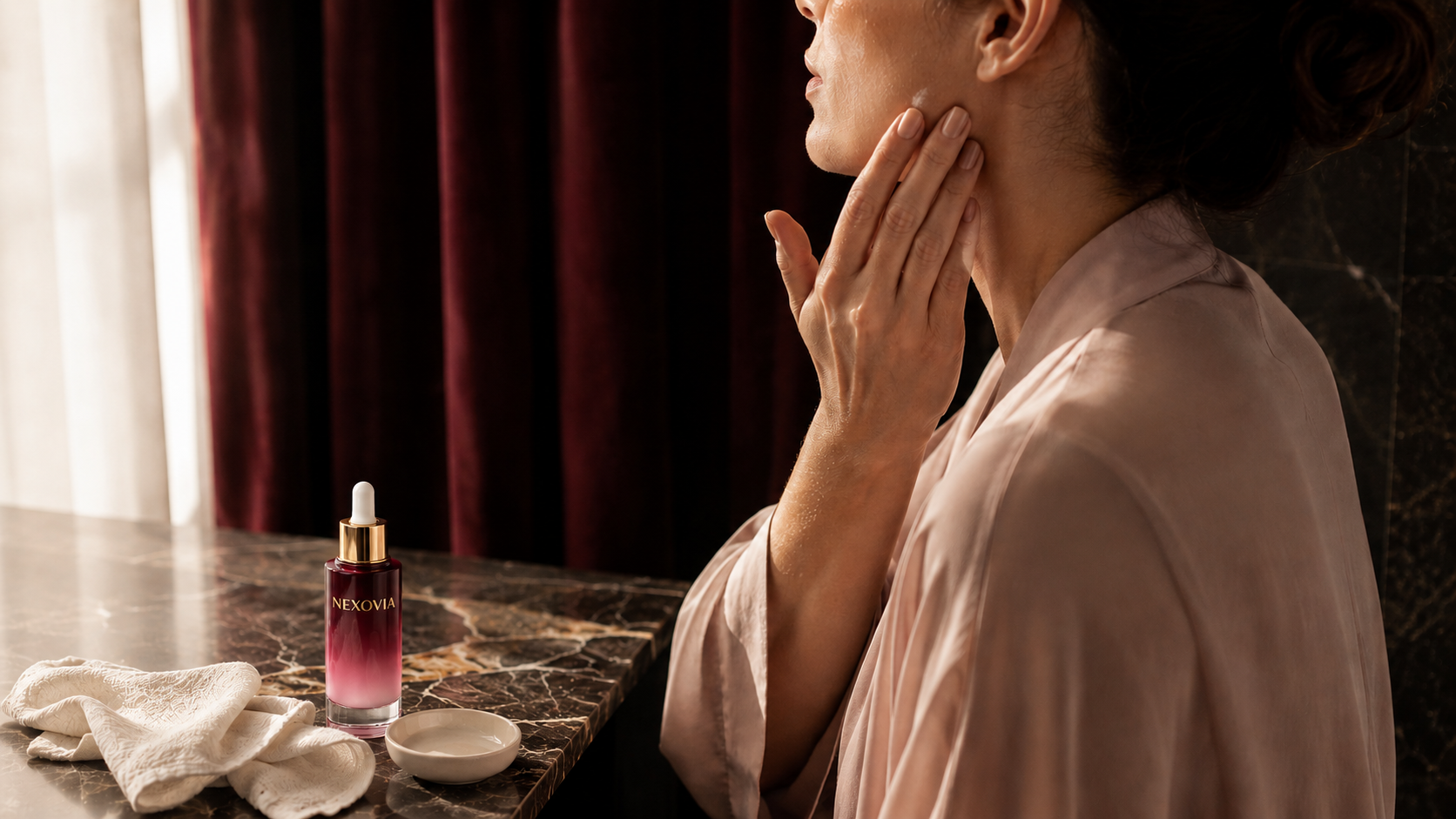
This piece outlines how to think about that routine. Not a list of products to buy, but a framework for the habits and the architecture that turns occasional treatment into durable improvement.
Treatment as the Punctuation, Routine as the Sentence
It is useful to think of aesthetic treatment and daily routine as occupying different temporal scales. Treatment intervenes acutely, on a timeline of weeks. The routine operates continuously, on a timeline of years. Both matter, but they do different work.
Treatment can produce structural change, new collagen, refined surface, reduced pigmentation, that the routine alone cannot. The routine, in turn, can preserve barrier integrity, modulate inflammation, support cellular function, and protect against the daily aggressions that erode the structural change treatment produced. Without the routine, results regress faster. Without the treatment, the routine maintains a state rather than improving it.
The Three Pillars of a Long-Term Routine
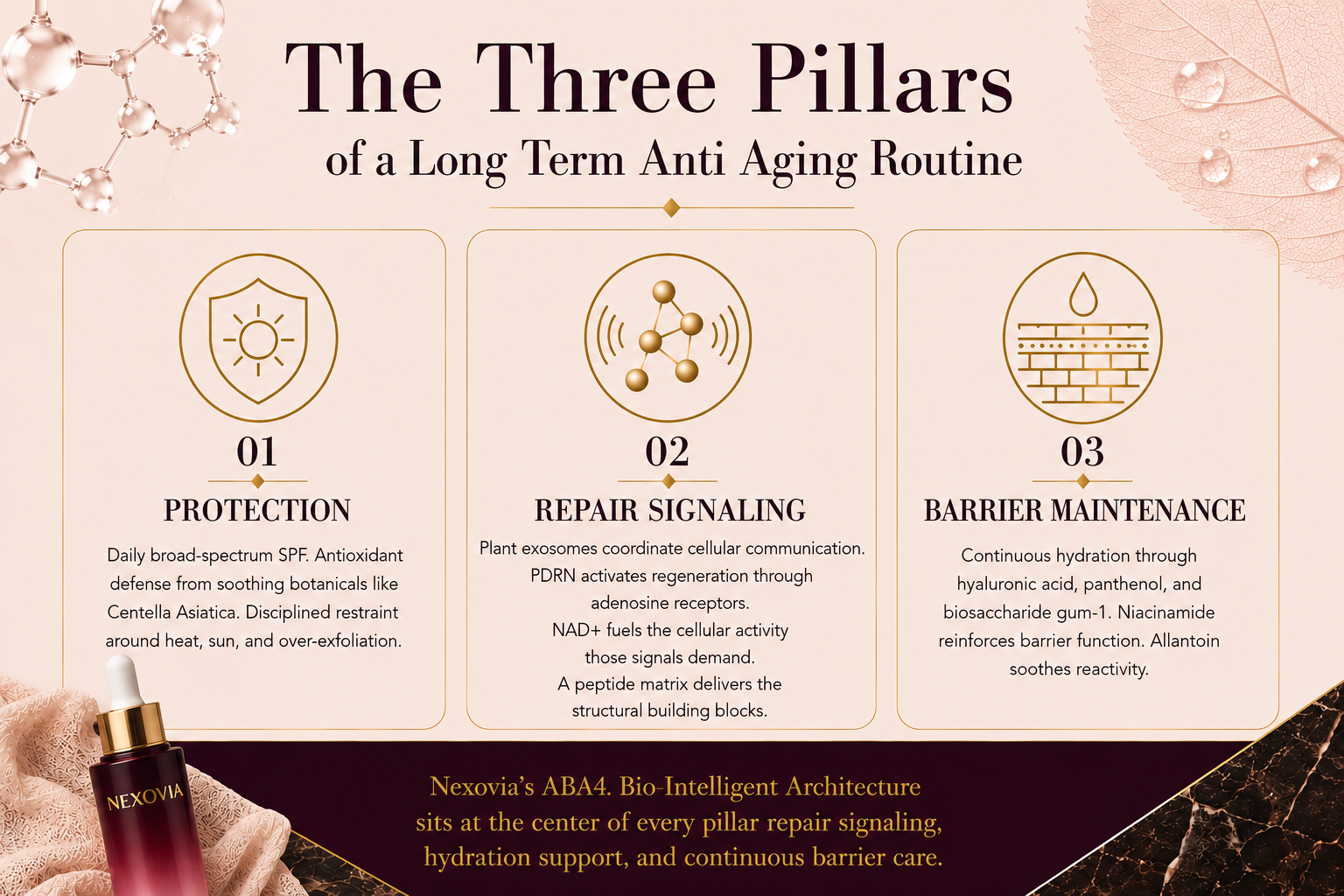
Reduced to its essentials, a sustainable anti-aging routine rests on three pillars: protection, repair signaling, and barrier maintenance. Every product in the routine should serve one of these three purposes; products that serve none are usually ornamental.
Protection is sun protection, antioxidant defense, and the discipline to avoid behaviors that compromise the skin: aggressive cleansing, over-exfoliation, exposure to extreme heat. Repair signaling is the consistent application of ingredients that prompt cellular repair and renewal: retinoids, peptides, growth factors, exosomes. Barrier maintenance is the continuous support of the skin's outermost layer through hydration, lipid replenishment, and the avoidance of disruption.
The Morning Routine
The morning is for protection. The skin spends the day exposed to the most aggressive environmental inputs it will face: ultraviolet radiation, visible light, pollutants, temperature variation, mechanical contact. The morning routine prepares the skin to withstand these without accumulating damage.
A gentle cleanse with water or a mild cleanser. A vitamin C antioxidant, in a tolerable formulation. A hydrator. A broad-spectrum sunscreen at SPF 30 or higher, applied generously, regardless of season or apparent weather. Sun discipline is the single most important variable in long-term skin appearance, regardless of any other choice in the routine.
The Evening Routine
The evening is for repair. The skin's natural processes of cellular turnover and tissue remodeling are most active during sleep, and the evening routine should provide the substrates and signals that support this.
A more thorough cleanse to remove sunscreen, makeup, and the day's accumulation. The application of repair-signaling ingredients: retinoids two to three nights a week, peptide-rich serums on the alternate nights, occasional exfoliation if your skin tolerates it. A barrier-supporting moisturizer to protect the layer through the night. Peptides and exosomes are particularly suited to evening application because their signaling work compounds with the body's natural overnight repair cycle.
Around the Treatment Itself
The week before and the week after a treatment require their own discipline. In the week before, actives are reduced and the barrier is conditioned to its calmest possible state. In the week after, the routine simplifies dramatically: hydration, soothing botanicals, sun avoidance, no actives. The discipline of pulling back at the right moments is what allows the treatment to deliver its full result.
Between treatments, the routine returns gradually to its full configuration. Retinoids are reintroduced when the practitioner approves. Vitamin C resumes. Exfoliation, if used, returns. The full architecture of protection, repair signaling, and barrier maintenance reassembles itself.
Why a Coordinated Architecture Outperforms Stacked Products
Long-term routines tend to accumulate products: a serum here, a treatment there, a new ingredient that promised something specific. Over years, this accumulation often produces redundancy and conflict rather than compounding benefit. The skin works best when the routine is built around a coordinated architecture rather than a stack of individual products that happen to share shelf space.
This is the design principle behind Nexovia's ABA.4 Bio-Intelligent Architecture. The peptide matrix delivers structural building blocks. Plant exosomes at four billion particles per millilitre coordinate cellular communication. PDRN at one percent activates regenerative pathways through adenosine receptors. NAD+ at one percent supplies the cellular energy that all of the above signaling demands. Each component does what it does best, and the combination produces an outcome that no single ingredient could deliver.
For long-term routines, this architecture becomes the consistent center around which the protection and barrier-maintenance components rotate. The morning protection layer changes seasonally; the evening repair architecture stays consistent. The skin responds to consistency more than to novelty.
Frequently Asked Questions
How often should I have aesthetic treatments?
It depends on the procedure and your goals. Microneedling and similar procedures are often spaced every four to eight weeks for an initial series, then maintained quarterly or semi-annually. Your practitioner will calibrate to your specific skin and the results you are seeking.
Can I skip the daily routine if I am having treatments regularly?
The treatments produce diminishing returns when the daily routine is poor. Sun damage, barrier compromise, and oxidative stress accumulate continuously between treatments. The routine prevents that accumulation; without it, treatments are essentially trying to repair damage that the routine could have prevented.
Is it necessary to use retinoids in a long-term routine?
Retinoids have the strongest evidence base of any topical for long-term anti-aging benefit. For most people, including some form of retinoid in the long-term routine produces meaningful additional benefit. The exception is skin that is unable to tolerate them, in which case peptides and other repair-signaling ingredients can substitute partially.
How important is consistency versus product quality?
Consistency outperforms quality, by a significant margin, over the long term. A simple, sustainable routine you actually follow daily produces better results than a sophisticated routine you abandon after three months.
When should I start a serious anti-aging routine?
The mid-twenties is a reasonable starting point for sun protection and barrier support. The early thirties is a reasonable starting point for repair signaling. Earlier than that is rarely necessary, except for sun protection, which should be lifelong.
This content is for informational purposes only and does not constitute medical advice. Always follow the specific aftercare instructions provided by your practitioner, as recommendations may vary based on your individual treatment and skin type.
Disclaimer: This article is for educational purposes only and is not medical advice. Always follow your provider's guidance after cosmetic procedures.