Journal
How Stress Affects Post-Procedure Skin Healing
Stress is not a soft factor in skin recovery. It is a measurable biological influence on inflammation, collagen synthesis, and barrier repair. Here is the mechanism.
September 15, 2026 / 6 min read
Stress is often discussed as a soft factor in skin health, vaguely associated with breakouts or dullness. The reality is more concrete. Stress affects post-procedure skin healing through specific, measurable biological pathways: it elevates cortisol, modulates inflammatory signaling, slows collagen synthesis, and impairs barrier repair. None of this is mystical. It is biochemistry.

This article explains how stress interferes with the recovery process, why the recovery window is a particularly important time to manage it, and what practical steps support the body's healing response when stress cannot be entirely eliminated.
The Cortisol Pathway
When the body perceives stress, the hypothalamic-pituitary-adrenal axis activates. Cortisol is released. In short bursts, this is useful: it mobilizes energy, sharpens attention, and prepares the body for action. Sustained elevation, the kind that comes from work pressure, sleep disruption, or emotional load over days or weeks, is a different matter entirely.
Sustained elevated cortisol slows the synthesis of collagen, weakens the immune response that supports wound healing, increases water loss through the skin, and dysregulates the inflammatory response that organizes tissue repair. Each of these effects, on its own, is modest. Stacked on top of a recovering procedure, they meaningfully extend the recovery window.
Inflammation: Useful in Pulses, Harmful When Sustained
Inflammation is part of the wound healing cascade. The initial phase of repair after a procedure is inflammatory: immune cells arrive, debris is cleared, the foundation for new tissue is laid. This inflammation is supposed to peak within 24 to 48 hours and resolve. Stress prolongs it.
Prolonged inflammation translates into longer-lasting redness, more visible swelling, and a slower transition into the proliferative phase of healing where new collagen and tissue are built. Patients who recover under high stress often describe a recovery that "drags on" beyond the practitioner's stated timeline. The mechanism is biochemical, not psychological.
Sleep, Repair, and the Stress Connection
Stress and sleep disruption are practically inseparable. Elevated cortisol interferes with the deep sleep stages where the body does its most active tissue repair. Reduced deep sleep, in turn, raises cortisol the next day. The cycle is self-reinforcing.
Skin repair is concentrated in the hours of slow-wave sleep. Sleep quality after a procedure is one of the most underappreciated variables in recovery speed. Patients who consistently get seven to eight hours of well-structured sleep through the recovery window typically recover faster than those who do not, regardless of their topical routine.
What Practical Steps Help
You cannot eliminate stress on demand, but you can reduce its impact during a recovery window. The following are the steps with the most direct evidence of effect.
First, prioritize sleep. Treat the week after a procedure as a non-negotiable sleep period. Aim for seven to eight hours, with consistent bed and wake times. Avoid alcohol, caffeine after midday, and screen exposure in the hour before bed.
Second, reduce workload visibly during the recovery window. The mistake patients often make is scheduling a treatment in the middle of a particularly demanding professional period. The treatment then competes with stress for the body's repair resources. Where possible, schedule treatments during quieter weeks.
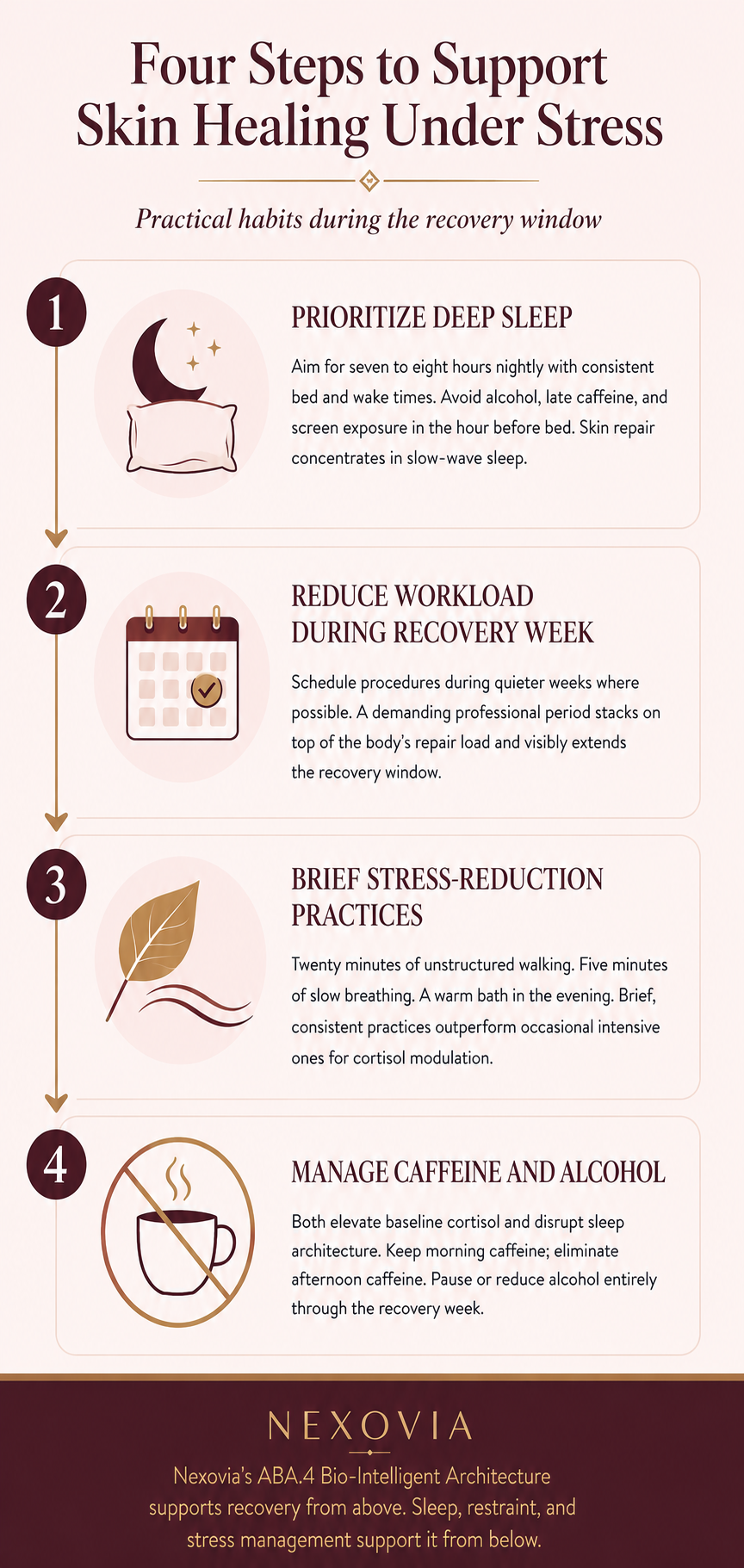
Third, incorporate brief stress-reduction practices. Twenty minutes of unstructured walking, five minutes of slow breathing, a hot bath in the evening: each of these has measurable effects on cortisol. They do not need to be elaborate or sustained. Brief, consistent practices outperform occasional intensive ones.
Fourth, manage caffeine and alcohol. Both elevate baseline cortisol. Both interfere with sleep architecture. Reducing them, even modestly, during the recovery window measurably improves the body's capacity to heal.
What Topical Care Cannot Compensate For
It is worth saying clearly: no topical product can fully compensate for sustained stress during a recovery window. The work of repair happens in the deeper layers of the skin, fueled by systemic processes that topical products only modestly influence. The most sophisticated post-procedure formulation supports repair; it does not replace the need for the body to be in a state where repair can happen.
This is not an argument against considered topical care; it is an argument for considering topical care as one of several variables, alongside sleep, nutrition, and stress management.
Why Architecture Plus Lifestyle Compounds Results
When the body's systemic state supports repair, the topical architecture amplifies it. Nexovia's ABA.4 Bio-Intelligent Architecture is designed for this compound effect. The peptide matrix delivers structural building blocks. Plant exosomes at four billion particles per millilitre coordinate cellular communication. PDRN at one percent activates regenerative pathways through adenosine receptors. NAD+ at one percent supplies the cellular energy that signaling and synthesis demand.
NAD+ in particular has direct relevance here. Cellular energy is the substrate that all repair processes draw from, and stress reduces it. Topical NAD+ does not undo systemic stress, but it provides cellular fuel at the surface where it is most needed. Combined with sleep, reduced workload, and brief stress-reduction practices, the recovery proceeds at the pace the procedure intended. NAD+ for skin is a useful deeper read on this mechanism.
Frequently Asked Questions
How significantly does stress actually slow recovery?
The effect varies but is meaningful. Studies on wound healing under stress typically show a 25 to 40 percent slower healing rate compared to controls. For aesthetic recovery, the practical translation is recovery windows that extend by two to four days rather than completing on the expected timeline.
Is exercise stress or stress relief during recovery?
Both, depending on intensity. Light to moderate exercise generally reduces stress and supports recovery. Intense exercise, particularly cardio that elevates heart rate and body temperature significantly, is best paused for the immediate recovery window. Resume gradually over the first week.
Does meditation actually help skin recovery?
Studies on meditation and inflammation show measurable reductions in inflammatory markers with consistent practice. The effect size is modest, but for recovery windows, modest effects matter. Twenty minutes daily produces more reliable benefit than occasional longer sessions.
What about caffeine specifically?
Moderate morning caffeine consumption is unlikely to significantly impair recovery. Late-day caffeine, particularly after 2pm, often disrupts sleep architecture and indirectly slows repair. The simplest adjustment is to maintain morning caffeine and eliminate afternoon caffeine during the recovery week.
Can I take supplements to support recovery under stress?
Vitamin C, zinc, and magnesium have evidence supporting their role in wound healing and stress modulation respectively. These are reasonable to maintain during a recovery window. Avoid loading up on supplements you have not used previously; novelty introduces unpredictability.
This content is for informational purposes only and does not constitute medical advice. Always follow the specific aftercare instructions provided by your practitioner, as recommendations may vary based on your individual treatment and skin type.
Disclaimer: This article is for educational purposes only and is not medical advice. Always follow your provider's guidance after cosmetic procedures.