Journal
What Ingredients to Avoid After Laser Treatment: A Complete Checklist
Your laser treatment is done, the redness is setting in, and now you are staring at your bathroom shelf wondering which of your trusted skincare products are safe to touch. The...
April 10, 2026 / 9 min read

Your laser treatment is done, the redness is setting in, and now you are staring at your bathroom shelf wondering which of your trusted skincare products are safe to touch. The retinol serum you swear by? The vitamin C you never skip? That exfoliating toner you use every evening? Before you reach for anything, pause. Several ingredients that benefit healthy skin can cause real problems when applied to a laser-treated face, and the consequences go beyond a little stinging.
Knowing which ingredients to avoid after laser treatment is one of the most important steps you can take to protect your investment and your results. When your skin barrier has been deliberately compromised by controlled thermal energy, certain active ingredients penetrate deeper than intended, trigger excessive inflammation, and can lead to complications like prolonged redness, irritation, or hyperpigmentation. This guide gives you a clear, ingredient-by-ingredient checklist so you can navigate your recovery with confidence.
Why Your Skin Is Especially Vulnerable After Laser Treatment
Laser skin resurfacing works by delivering concentrated light energy that removes or heats damaged skin layers, triggering an intensive regenerative response. Whether you received an ablative treatment like CO2 or Erbium, or a non-ablative procedure, your skin's protective barrier has been significantly disrupted.
Your stratum corneum, the outermost shield that normally keeps irritants out and moisture in, is temporarily weakened. Transepidermal water loss increases dramatically, and your skin becomes far more permeable than usual. Ingredients that would sit on the surface of healthy skin now have a direct pathway into deeper, more sensitive layers. This heightened absorption is exactly what makes beneficial aftercare ingredients so effective during this window, but it is also what makes the wrong ingredients potentially harmful.
Understanding this vulnerability is the key to understanding why your entire skincare routine needs to be simplified during the healing period.
The Complete Checklist: Ingredients to Avoid
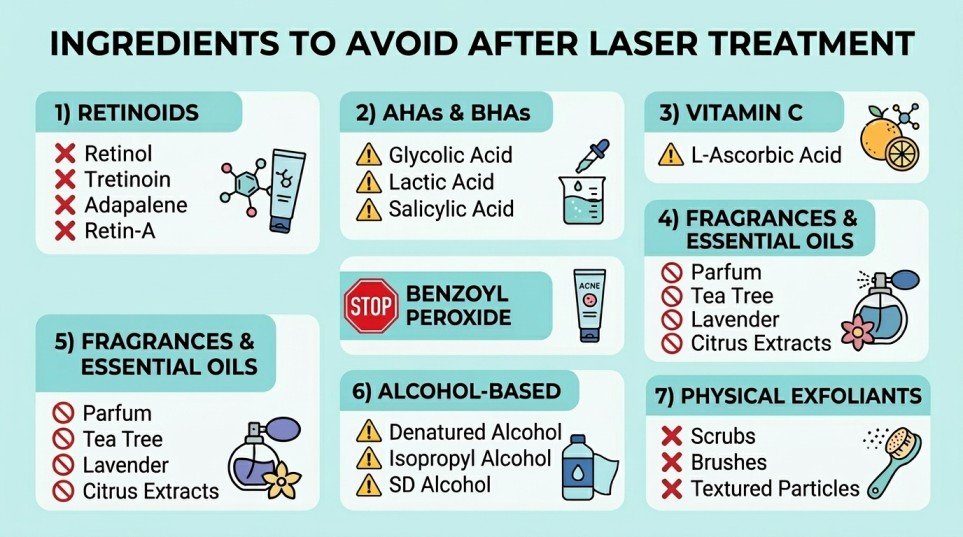
Retinoids
Retinoids, including retinol, tretinoin, adapalene, and Retin-A, are among the most widely recognized ingredients to avoid after laser treatment. While retinoids are excellent for anti-aging and acne on intact skin, they work by accelerating cell turnover and can be inherently irritating even under normal conditions. On a barrier-compromised face, retinoids can trigger excessive peeling, intense redness, and prolonged inflammation that delays healing rather than supporting it. Most practitioners recommend avoiding all retinoids for a minimum of two weeks after laser treatment, with some advising four to six weeks depending on treatment intensity.
Alpha Hydroxy Acids and Beta Hydroxy Acids
AHAs like glycolic acid and lactic acid, along with BHAs like salicylic acid, are chemical exfoliants designed to dissolve dead skin cells and promote turnover. After laser treatment, your skin has already undergone significant controlled injury. Adding chemical exfoliation on top of this overwhelms the healing process, creating excessive inflammation and increasing the risk of post-inflammatory hyperpigmentation. These acids are commonly found not only in dedicated exfoliating products but also in cleansers, toners, and even some moisturizers, so check your ingredient labels carefully.
Vitamin C (L-Ascorbic Acid)
This one surprises many patients. Vitamin C is celebrated for its brightening and antioxidant benefits, but in its active L-ascorbic acid form, it has a low pH that can sting, irritate, and inflame freshly treated skin. The acidic nature of potent vitamin C serums makes them too aggressive for a compromised barrier. Some patients who reintroduce vitamin C too early notice patchy redness or uneven pigmentation. Wait until your skin feels fully calm and your practitioner approves before bringing vitamin C back into your routine.
Benzoyl Peroxide
If you use benzoyl peroxide for acne management, it must be paused during laser recovery. Benzoyl peroxide is highly drying and creates an oxidizing reaction on the skin that can be extremely irritating to healing tissue. Using it too soon can lead to severe dryness, cracking, and compromised wound healing.
Fragrances and Essential Oils
Fragrance, whether synthetic or derived from essential oils like tea tree, eucalyptus, lavender, or citrus extracts, is one of the most underestimated sources of post-laser irritation. These ingredients can trigger inflammatory responses even if you have tolerated them without issue on healthy skin. Post-laser skin is not the time to rely on products labeled "natural," as natural does not mean gentle on a compromised barrier. Check ingredient lists for parfum, fragrance, and specific essential oil names.
Alcohol-Based Products
Denatured alcohol, isopropyl alcohol, and SD alcohol appear in many toners, astringents, and acne treatments. These ingredients strip moisture from the skin and dissolve protective lipids in the barrier, exactly the opposite of what healing skin needs. Products containing alcohol high in the ingredient list should be set aside until your recovery is complete.
Physical Exfoliants
Scrubs, cleansing brushes, exfoliating cloths, and any product with gritty or textured particles create mechanical friction that can damage the delicate new tissue forming after laser treatment. Your skin needs time to regenerate naturally without being forced. Premature physical exfoliation can cause micro-tears, prolonged redness, and uneven texture.
What You Can Safely Use Instead
With so many ingredients off the table, you might wonder what is left. The goal during laser recovery is simple: calm, hydrate, and protect. Your skin needs ingredients that reduce inflammation, replenish lost moisture, and support the barrier rebuilding process without overstimulating sensitive tissue.
Hyaluronic acid draws moisture into the skin, counteracting the increased transepidermal water loss that follows laser treatment. Niacinamide supports barrier repair and helps manage inflammation without irritating healing skin. Centella Asiatica, also known as cica, has been used for centuries for its wound healing and soothing properties. Panthenol provides both hydration and anti-inflammatory benefits. Ceramides help restore the lipid layer of the barrier that was disrupted during treatment.
Products that combine multiple barrier-supporting and anti-inflammatory ingredients provide more comprehensive recovery support than single-ingredient formulations. When your aftercare addresses hydration, inflammation, cellular repair, and barrier restoration simultaneously, your skin has the best conditions for efficient, even healing.
Supporting Your Recovery With the Right Aftercare
During days one through seven, apply Nexovia Skin Serum at 1mL in the morning and 1mL at night. The ABA.4 Aesthetic Bio-Amplifier architecture delivers plant exosomes to modulate inflammation, PDRN to activate tissue regeneration pathways, NAD+ to fuel the cellular energy your skin requires for repair, and a peptide matrix to rebuild the extracellular matrix. Follow with a bland moisturizer and broad-spectrum SPF 50 or higher during the day.
During days eight through fourteen, apply Nexovia at 0.5mL in the morning and 0.5mL at night as your barrier continues restoring.
After day fourteen, continue applying Nexovia once daily until the 30mL bottle is finished to maintain results and support ongoing skin health. Reintroduce your regular active ingredients one at a time, only as your practitioner approves, to monitor how your skin responds.
Choosing Aftercare Designed for Post-Laser Skin
When your recovery products are purpose-built for the specific challenges of barrier-compromised skin, you eliminate the guesswork and reduce the risk of accidentally introducing an ingredient that sets your healing back.
This is exactly why Nexovia's Skin Serum was formulated with its ABA.4 Aesthetic Bio-Amplifier architecture. The formula combines plant exosomes at 4 billion particles per milliliter, PDRN at 1% concentration, NAD+ at 1% concentration, and a peptide matrix including growth factors. This bio-intelligent aftercare addresses recovery from multiple angles simultaneously, designed to soothe instantly, support barrier recovery, and amplify your final results.
Made in South Korea and developed specifically for the post-procedure experience, Nexovia represents the next generation of aftercare formulated to work with your skin's natural healing processes.
Nexovia Skin Serum launches in June 2026. Register for early access to be among the first to experience bio-intelligent aftercare designed specifically for post-procedure recovery.
Frequently Asked Questions
When can I use retinol again after laser treatment?
Most practitioners recommend waiting a minimum of two weeks before reintroducing retinoids, though this timeline can extend to four to six weeks for more intensive ablative laser treatments. The key indicator is how your skin feels. If you still notice sensitivity, tightness, or visible redness, your barrier has not fully recovered and retinol should continue to wait. When you do reintroduce it, start with a lower concentration than you typically use and apply every other night to gauge your skin's response.
Can I use niacinamide after laser treatment?
Niacinamide is generally considered safe and even beneficial after laser treatment. Unlike the active ingredients on the avoid list, niacinamide is non-exfoliating and non-acidic. It supports barrier repair, helps manage redness, and provides anti-inflammatory benefits that complement the healing process. However, always check that your niacinamide product does not contain other active ingredients like AHAs or retinol that should be avoided during recovery.
Is hyaluronic acid safe to use after laser treatment?
Hyaluronic acid is one of the most recommended ingredients for post-laser recovery. It is a naturally occurring molecule that draws moisture into the skin, helping counteract the dehydration and tightness caused by increased transepidermal water loss. It is non-irritating, compatible with sensitive skin, and supports the hydrated environment your skin needs for optimal healing.
How do I know when my skin is ready for active ingredients again?
Your skin will communicate when it is ready. Signs that your barrier has sufficiently recovered include the absence of visible redness or pinkness, no tightness or sensitivity to gentle touch, skin that feels comfortable without constant moisturizing, and tolerance of lukewarm water without stinging. When reintroducing actives, add one product at a time and wait several days before adding another. This approach lets you identify any ingredient that your skin is not yet ready for.
Why is mineral sunscreen recommended over chemical sunscreen after laser?
Chemical sunscreens contain active filters like oxybenzone and avobenzone that absorb UV rays through a chemical reaction. This process can generate heat and irritation on sensitive, healing skin. Mineral sunscreens use zinc oxide or titanium dioxide to physically block UV rays without chemical absorption, making them gentler and better tolerated during the recovery window. Choose a broad-spectrum mineral SPF 50 or higher and reapply every two hours when exposed to sunlight.
This content is for informational purposes only and does not constitute medical advice. Always follow the specific aftercare instructions provided by your practitioner, as recommendations may vary based on your individual treatment and skin type.


