Journal
For Clinics: Why Standardized Aftercare Protocols Improve Patient Satisfaction and Revenue
Every aesthetic practitioner recognizes the scenario. A patient calls two days after their microneedling treatment, anxious about redness that is completely normal for their...
February 28, 2026 / 11 min read

Every aesthetic practitioner recognizes the scenario. A patient calls two days after their microneedling treatment, anxious about redness that is completely normal for their stage of recovery. Another patient emails photos of mild peeling after a chemical peel, concerned something has gone wrong. A third patient used an inappropriate product from their medicine cabinet and is now dealing with irritation that extends their downtime.
These situations consume staff time, create patient anxiety, and occasionally result in outcomes that fall short of expectations. The common thread is inconsistent or inadequate aftercare guidance. When patients leave your clinic without a clear, standardized protocol and appropriate products, variability in their home care introduces variability in their results.
Standardized aftercare protocols address this challenge systematically. By providing every patient with consistent guidance and professional-grade products, clinics can reduce post-procedure complications, improve patient satisfaction, decrease support burden, and create additional revenue. This article examines the business case for standardized aftercare and provides a framework for implementation.
The Hidden Costs of Inconsistent Aftercare
Before exploring solutions, it is worth quantifying the problems that inconsistent aftercare creates for aesthetic practices.
Staff Time and Operational Burden
Post-procedure patient inquiries consume significant staff resources. Each phone call or email requires time to assess, reassure, and guide. When patients lack clear protocols, the volume of these communications increases substantially.
Consider a practice performing fifty aesthetic procedures weekly. If even twenty percent of patients call with aftercare concerns, that represents ten additional patient interactions per week. At fifteen minutes per interaction, this totals over two hours of staff time weekly devoted to reactive support rather than productive activities. Annually, this translates to over one hundred hours of staff time. Standardized protocols with clear expectations reduce these inquiries by addressing common concerns proactively.
Patient Anxiety and Satisfaction Impact
Patient satisfaction scores increasingly influence practice success. Online reviews, referrals, and repeat bookings all correlate with patient experience. Anxiety during recovery, even when outcomes are ultimately good, negatively impacts satisfaction.
Patients who feel uncertain about their aftercare experience stress that colors their perception of the entire treatment journey. They may leave lukewarm reviews despite excellent clinical results simply because the recovery period felt unsupported. Conversely, patients who feel confident and cared for throughout recovery report higher satisfaction even when experiencing normal healing challenges like redness or tightness.
Outcome Variability
Clinical outcomes depend partly on factors beyond the treatment room. A perfectly executed procedure can be compromised by inappropriate aftercare. When patients use harsh products, neglect sun protection, or fail to support barrier recovery, results suffer.
This variability creates challenges for practitioners. Outcomes become less predictable, making it harder to set appropriate expectations. Occasional complications require additional appointments. Some patients attribute suboptimal results to the procedure itself rather than aftercare failures, damaging your clinical reputation unfairly.
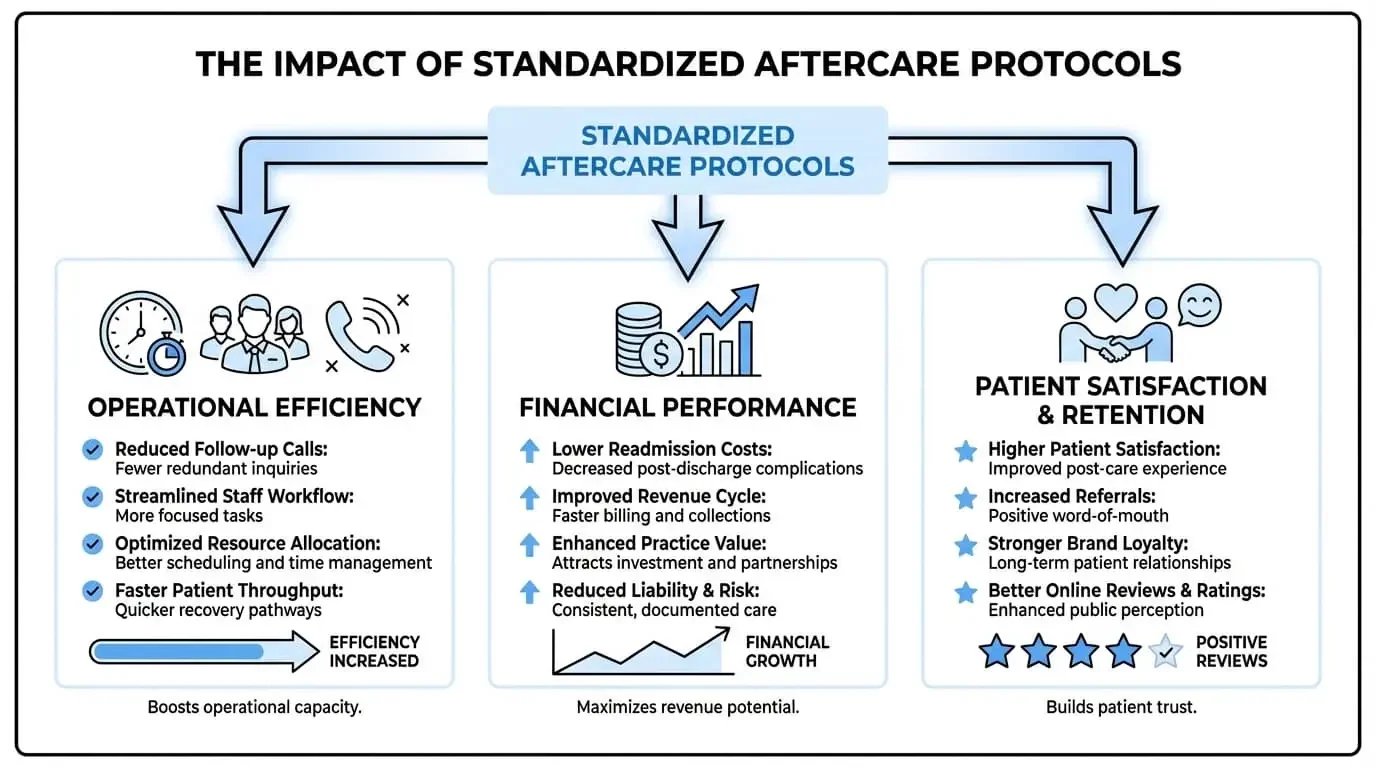
The Business Case for Standardization
Beyond addressing problems, standardized aftercare protocols create positive business opportunities.
Improved and More Predictable Clinical Outcomes
When every patient follows an evidence-based protocol with appropriate products, average outcomes improve and outcome variance decreases. Barriers heal faster, complications decrease, and patients achieve results closer to their potential. Practitioners who implement standardized protocols consistently report that patients heal more predictably, with fewer instances of prolonged redness, unexpected sensitivity, or suboptimal results.
This predictability benefits clinical communication. When you can confidently tell a patient what to expect at each stage of recovery because your protocol produces consistent results, trust increases and anxiety decreases.
Enhanced Patient Loyalty and Retention
Patients who have positive recovery experiences return for additional treatments and recommend your practice. The aftercare experience significantly influences this perception. A patient who feels supported and achieves excellent results becomes a practice advocate.
Standardized protocols also create continuity across multiple treatments. Patients appreciate knowing what to expect each time they visit. This consistency builds the long-term patient-practice relationship that sustains revenue growth.
Retail Revenue Opportunity
Professional aftercare products represent a revenue stream that many practices underutilize. When you recommend specific products as part of your protocol, patients purchase them directly from your practice. This revenue is high-margin and requires minimal additional effort when integrated into existing workflows.
The key is that the recommendation is clinical, not retail. You are not upselling a product. You are prescribing a recovery protocol that includes a specific, purpose-built product. This distinction matters for both patient trust and staff comfort with the recommendation.
Competitive Differentiation
In competitive markets, patient experience differentiates practices. Comprehensive aftercare protocols signal a level of care and professionalism that distinguishes your practice from competitors who hand patients a generic instruction sheet and wish them luck.
When prospective patients research practices, attention to aftercare demonstrates commitment to results beyond the treatment room. This comprehensive approach appeals to discerning patients willing to invest in quality care, the patients most practices want to attract.
Components of an Effective Standardized Protocol
Effective aftercare protocols share certain characteristics regardless of specific procedure types.
Clear Written Instructions
Every patient should leave with written instructions specific to their procedure covering expected recovery timeline, daily care routine, products to use and products to avoid, warning signs that warrant contacting the clinic, and answers to the most common questions. Written instructions reduce reliance on patient memory and provide a reference throughout recovery. They should be clear, specific, and professionally presented.
A Single, Multi-Technology Aftercare Product
This is where most protocols fail. Recommending "a gentle moisturizer" or "a hydrating serum" leaves patients to navigate an overwhelming market of products, most of which are not formulated for post-procedure skin. The result is the variability you are trying to eliminate.
The ideal protocol centers on a single, purpose-built aftercare product that addresses multiple recovery needs simultaneously: inflammation modulation, tissue regeneration, cellular energy support, and barrier repair. One product simplifies the protocol, improves compliance, and eliminates the risk of patients choosing inappropriate alternatives.
Proactive Communication
Rather than waiting for patients to call with concerns, proactive communication addresses questions before they arise. Follow-up messages at key recovery milestones (Day 2, Day 7) demonstrate care while actually reducing total communication burden by preventing anxiety-driven inquiries.
Staff Training and Consistency
Every team member who interacts with patients should communicate consistent aftercare information. When different staff members provide different guidance, patient confidence decreases and confusion increases. Regular training ensures all team members understand protocols deeply enough to answer questions confidently.
Why Multi-Technology Formulations Simplify Protocol Design
The science behind post-procedure recovery explains why a multi-technology approach is superior to recommending multiple single-ingredient products.
After any aesthetic procedure, the skin faces simultaneous challenges: the barrier is compromised, inflammation is elevated, cells need energy to execute repairs, tissue regeneration pathways need activation, and the extracellular matrix needs rebuilding signals. These are not sequential problems. They occur at the same time and interact with each other.
A protocol built around separate products for each challenge (one for hydration, one for inflammation, one for repair) introduces complexity that reduces compliance and increases the chance of product interactions or errors. A single formulation engineered to address all of these challenges simultaneously simplifies everything: the protocol is easier to explain, easier to follow, and produces more consistent results.
The technologies that matter for post-procedure recovery include plant exosomes for cellular communication and inflammation modulation, PDRN for tissue regeneration via adenosine A2A receptor activation, NAD+ for cellular energy and DNA repair, and peptides with growth factors for extracellular matrix rebuilding. When these technologies are combined in a single formulation at clinically meaningful concentrations, the result is a protocol cornerstone that addresses the full spectrum of recovery needs.
Implementing a Standardized Protocol in Your Practice
Protocol Structure
A practical protocol that works across microneedling, laser treatments, chemical peels, IPL, and RF procedures follows a phased approach aligned with the biology of recovery.
- Day 0 (In-Clinic): Following treatment completion and standard cooling or hemostasis, apply the aftercare serum. Immediate application takes advantage of enhanced penetration to deliver active ingredients when they provide maximum benefit. Send the patient home with their product and written instructions.
- Days 1 through 7 (Acute Recovery): Patient applies the aftercare serum morning and evening, followed by a simple moisturizer and SPF 50 during the day. Clear dosing guidance (specific milliliter amounts) eliminates ambiguity and improves compliance.
- Days 8 through 14 (Active Healing): Patient reduces serum application as acute recovery transitions to restoration. Continue avoiding active ingredients and maintaining sun protection.
- Day 15 onward (Maintenance): Patient continues serum once daily until finished, supporting ongoing results. Gradual reintroduction of normal skincare products.
This structure provides clear guidance while accommodating the different recovery trajectories of various procedures. For more intensive treatments, simply extend the acute phase timeline.
Integration Into Existing Workflows
Protocol implementation should add minimal complexity to your current operations. The aftercare product is dispensed at checkout alongside the written instruction card. Staff explains the protocol in two to three minutes using standardized talking points. The patient leaves with everything they need.
Follow-up communication can be automated: a Day 2 text message reinforcing key instructions and a Day 7 check-in. These touchpoints reduce inbound inquiries while demonstrating proactive care.
Nexovia as Your Protocol Cornerstone
Nexovia Skin Serum was developed specifically to serve as the centerpiece of standardized clinic aftercare protocols. The ABA.4 Bio-Intelligent Architecture delivers four synergistic technologies in a single formulation:
Plant exosomes at 4 billion particles per milliliter for cellular communication and inflammation modulation. PDRN at 1% (10,000 PPM) for tissue regeneration via adenosine A2A receptor activation. NAD+ at 1% for cellular energy, DNA repair, and sirtuin activation. A peptide matrix with EGF-mimetics and matrikines for extracellular matrix rebuilding.
This multi-technology approach means one product addresses the full spectrum of post-procedure recovery needs. Clinics standardize on a single SKU across all procedure types rather than maintaining multiple product lines, simplifying inventory, training, and patient communication.
Manufactured in South Korea using the advanced formulation science and quality standards that Korean post-procedure skincare is known for, Nexovia provides the credibility and clinical performance that practitioners require from a protocol product.
Measuring Protocol Success
Implementing standardized protocols creates opportunities for measurement and continuous improvement.
Track post-procedure call and email volume to quantify support burden reduction. Monitor patient satisfaction scores and online review sentiment. Document complication rates and outcome consistency across patients. Measure aftercare product attachment rate (percentage of procedure patients who leave with the protocol product) and the associated retail revenue contribution.
Comparing these metrics before and after protocol implementation demonstrates value to practice leadership and identifies areas for refinement.
Partnership Opportunities
Nexovia is committed to supporting aesthetic practices in delivering optimal patient outcomes. Clinic partnerships include staff training on product science and protocol implementation, patient education materials that can be customized with clinic branding, dedicated support for protocol questions, and competitive wholesale pricing structured for retail margin.
Nexovia Skin Serum launches in April 2026. Practices interested in implementing standardized aftercare protocols can inquire about early partnership opportunities.
Frequently Asked Questions
How do standardized protocols affect patient compliance?
Standardized protocols improve compliance compared to generic aftercare advice. When patients receive a specific product and clear instructions as part of their treatment experience, they are significantly more likely to follow through than when given vague guidance to "find a gentle moisturizer." The professional recommendation carries clinical weight that generic advice lacks, and having the product in hand at checkout eliminates the barrier of a separate shopping trip.
Can one aftercare product work across different procedure types?
Yes, when the product addresses the fundamental challenges common to all post-procedure skin: barrier compromise, inflammation, increased water loss, and repair demands. The ABA.4 architecture addresses these shared challenges through four complementary technologies, making it appropriate across microneedling, laser treatments, chemical peels, IPL, and RF procedures. Protocol timing may vary by procedure intensity, but the product remains consistent.
What if patients want to use products they already own?
Education helps patients understand why professional aftercare products differ from daily skincare. Position the aftercare product as a short-term clinical tool that protects their procedure investment, similar to how a post-surgical patient uses prescribed wound care rather than household supplies. Most patients readily accept this framing, especially when the recommendation comes from their trusted practitioner.
How do we handle complications despite protocol adherence?
Standardized protocols do not eliminate all complications, but they reduce frequency and provide documentation of recommended care. When complications occur, you can assess whether the protocol was followed and respond appropriately. Consistent protocols also make pattern recognition easier across your patient population, helping identify systemic issues versus individual outliers.
What training is required for staff?
Staff should understand the rationale behind protocol components, specific product instructions, answers to common patient questions, and when to escalate concerns to practitioners. Nexovia provides training materials to support implementation. Most practices report that one training session of thirty to sixty minutes is sufficient for confident, consistent staff communication.
This content is for informational purposes only and does not constitute medical advice. Always follow the specific aftercare instructions provided by your practitioner, as recommendations may vary based on your individual treatment and skin type.


