Journal
RF Microneedling vs Traditional Microneedling: Recovery Differences Explained
You have been researching microneedling treatments and now face a decision: traditional microneedling or RF microneedling? Both promise impressive results for skin texture,...
March 5, 2026 / 8 min read

You have been researching microneedling treatments and now face a decision: traditional microneedling or RF microneedling? Both promise impressive results for skin texture, fine lines, and overall rejuvenation. Both create controlled micro-injuries that stimulate your body's natural healing response. But when it comes to recovery, are they really the same?
The short answer is that RF microneedling typically involves slightly more intensive recovery than traditional microneedling due to the added thermal energy component. However, the fundamental aftercare principles remain similar for both. This guide breaks down exactly what to expect from each treatment during the healing process and how to support your skin through recovery regardless of which option you choose.
Understanding the Core Difference
Before exploring recovery differences, it helps to understand what distinguishes these two treatments at a fundamental level.
Traditional microneedling uses fine needles to create thousands of controlled micro-punctures in the skin. These micro-injuries trigger your body's wound healing cascade, stimulating collagen production and cellular renewal. The treatment is purely mechanical, relying on the physical punctures to initiate the regenerative response.
RF microneedling adds radiofrequency energy to the equation. The needles not only puncture the skin but also deliver thermal energy into the deeper dermal layers. This heat causes controlled thermal damage that triggers additional collagen contraction and remodeling beyond what mechanical injury alone produces. Devices like Morpheus8, Potenza, Genius, and Vivace fall into this category. The combination of micro-channels plus thermal energy creates a more intensive treatment that can address concerns like skin laxity more effectively than traditional microneedling alone.
This added thermal component is precisely why recovery experiences differ between the two treatments.
Traditional Microneedling Recovery Timeline
While individual experiences vary based on treatment intensity, skin type, and aftercare practices, the following represents a typical recovery pattern.
Days 0 to 1
Immediately after treatment, your skin appears red and feels warm, similar to a mild to moderate sunburn. Some patients experience minor pinpoint bleeding during the procedure, but this stops quickly. Skin feels tight and sensitive.
Days 2 to 3
Redness begins transitioning from intense to a milder pink tone. Sensitivity decreases, and the sunburn sensation fades. Some patients notice mild dryness as the healing process progresses.
Days 4 to 5
Most visible redness has resolved for the majority of patients. Skin may still feel slightly sensitive, and light flaking can occur as the outer layer renews.
Days 6 to 7
Skin typically returns to normal appearance. Residual sensitivity is minimal, and most patients feel comfortable resuming their regular activities and skincare routines.
RF Microneedling Recovery Timeline
Days 0 to 1
Redness and warmth are typically more pronounced than with traditional microneedling due to the thermal component. Swelling is more common, particularly around the eyes and jawline. The skin may appear more uniformly red rather than showing the pinpoint pattern sometimes visible after traditional treatment.
Days 2 to 3
Redness remains more visible than it would at this stage with traditional microneedling. Swelling begins to subside. Skin feels tight, and some patients report a slightly rough or sandpaper-like texture as the thermal effects progress through the healing phases.
Days 4 to 5
Redness continues fading but may still be noticeable. Dryness and light peeling are common as the skin sheds the treated outer layers. The texture irregularity typically resolves during this phase.
Days 6 to 7
Most patients see significant improvement, though subtle pinkness may persist longer than with traditional microneedling. Sensitivity is largely resolved.
Days 8 to 14
Any remaining pinkness fades completely. Skin feels fully recovered on the surface, though collagen remodeling continues beneath for months.
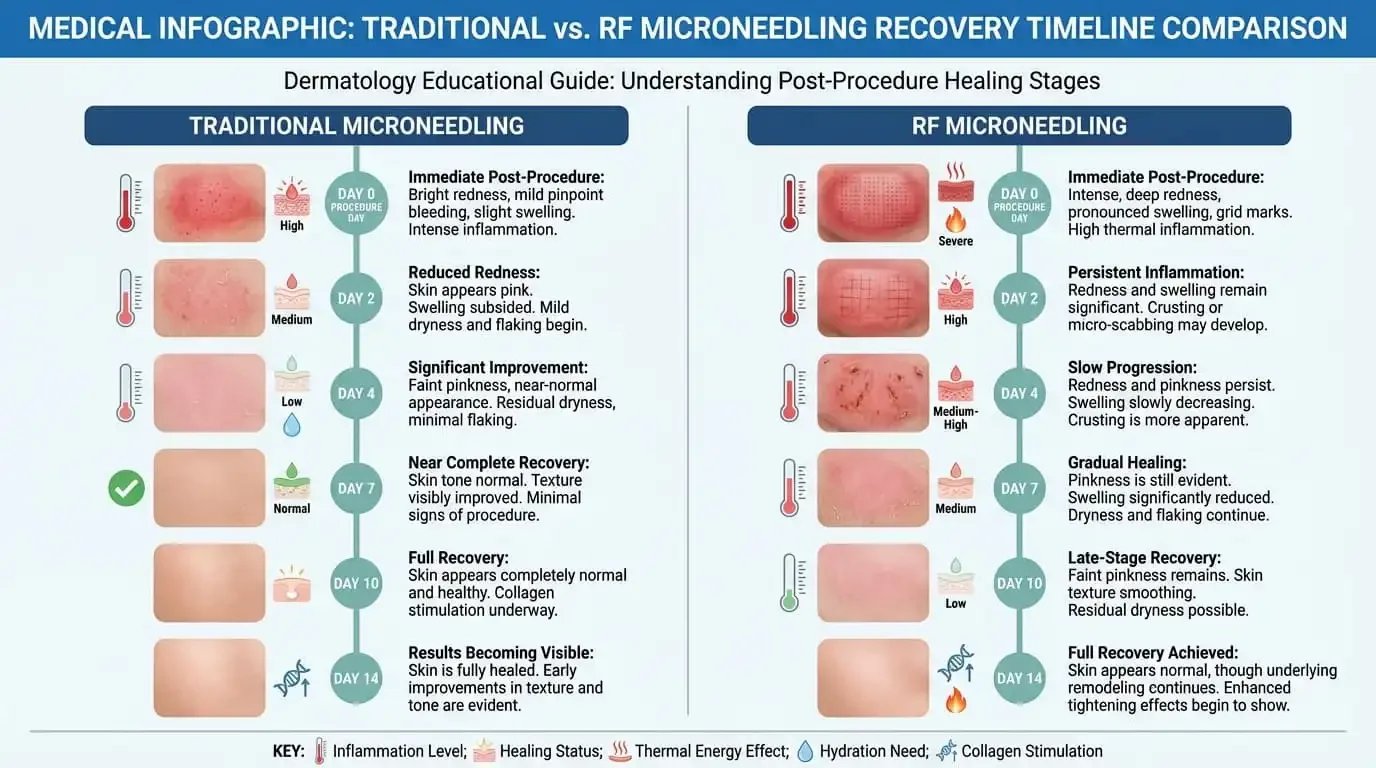
Key Recovery Differences Explained
Several specific factors account for the differences in recovery experience between these two treatments.
Intensity of Redness
RF microneedling typically produces more intense and longer-lasting redness because the thermal energy creates additional inflammation beyond the mechanical micro-injuries. The heat causes controlled damage to dermal structures, which requires more robust healing. Expect redness to persist one to three days longer with RF microneedling compared to traditional treatment.
For a detailed breakdown of what affects redness duration, see our guide on how long redness lasts after microneedling.
Swelling Patterns
Swelling is more common and more noticeable with RF microneedling. The thermal energy affects deeper tissue layers, triggering more fluid accumulation as part of the inflammatory response. This swelling is usually most pronounced on day one and two, particularly in areas with thinner skin like around the eyes. Traditional microneedling may cause mild swelling, but it is typically less significant.
Skin Texture During Healing
Some RF microneedling patients notice a temporary rough or sandpaper-like texture during days two through four that is less common with traditional microneedling. This occurs because the thermal energy affects the skin differently than pure mechanical punctures. The texture normalizes as healing progresses and is not a cause for concern.
Peeling and Flaking
Both treatments can cause light peeling or flaking as the skin renews, but this tends to be slightly more pronounced with RF microneedling. The thermal damage to the outer layers results in more visible shedding as fresh skin emerges beneath.
Overall Downtime
Traditional microneedling typically involves three to five days of visible recovery for most patients. RF microneedling extends this to five to seven days on average, with some patients experiencing subtle residual effects through day ten. Planning your schedule accordingly helps you navigate either treatment with minimal disruption.
Aftercare Principles That Apply to Both Treatments
Despite the differences in recovery intensity, the fundamental aftercare approach remains similar for both RF and traditional microneedling. Your skin faces the same core challenges with either treatment: barrier compromise, increased transepidermal water loss, inflammation, and the need for tissue repair.
For both treatments, your aftercare during the first two weeks should focus on gentle cleansing with a non-foaming, fragrance-free cleanser. Apply a post-procedure serum containing calming and repairing ingredients like plant exosomes, PDRN, NAD+, peptides, hyaluronic acid, and centella asiatica. Follow with a simple moisturizer and broad-spectrum SPF 50 every morning. Avoid all active ingredients including retinoids, AHAs, BHAs, vitamin C, and benzoyl peroxide.
For the full day-by-day routine, see our complete microneedling aftercare guide. For ingredient guidance, see our guide on what to put on your face after microneedling.
Additional Considerations for RF Microneedling Aftercare
Because RF microneedling creates more inflammation through its thermal component, a few extra precautions are worth noting.
Some practitioners recommend extending the strict avoidance of active ingredients by a few extra days beyond the standard two-week window. The thermal component also makes sun protection even more critical, as heat-damaged skin is particularly vulnerable to UV-induced hyperpigmentation. Be especially diligent with SPF application and sun avoidance during the first two weeks.
If you experience more pronounced swelling, sleeping with your head slightly elevated for the first two nights can help reduce fluid accumulation. Avoid heat sources like saunas, hot showers, and steam rooms for at least 72 hours, as adding external heat to already thermally treated skin can worsen inflammation.
Not sure which aftercare approach is right for your specific treatment?
Frequently Asked Questions
Is RF microneedling recovery significantly harder than traditional microneedling?
RF microneedling recovery is slightly more intensive but not dramatically different. You can expect one to three additional days of visible redness and potentially more swelling during the first 48 hours. The fundamental experience is similar, and with proper aftercare, most patients navigate recovery comfortably. The added thermal component produces more significant collagen stimulation, which many patients find worth the slightly extended downtime.
Can I use the same aftercare products for both RF and traditional microneedling?
Yes, the same aftercare principles and products apply to both treatments. Your skin faces similar challenges with both procedures, including barrier compromise, inflammation, and the need for tissue repair. Products formulated with multiple complementary technologies like plant exosomes, PDRN, NAD+, and peptides, such as Nexovia Skin Serum with its ABA.4 architecture, support recovery effectively for either treatment type.
Which treatment has less downtime if I have an important event coming up?
Traditional microneedling typically offers shorter visible downtime, with most patients looking presentable by day four or five. RF microneedling may require six to seven days before visible recovery is complete. If you have a specific event, schedule traditional microneedling at least five days before and RF microneedling at least seven to ten days before to allow adequate healing time.
Is Morpheus8 recovery the same as other RF microneedling devices?
Morpheus8 is one of the most popular RF microneedling devices, alongside Potenza, Genius, and Vivace. Recovery is generally similar across RF microneedling devices, though the specific settings your practitioner uses (needle depth, RF energy level, number of passes) have a greater impact on recovery than the device brand itself. The aftercare principles outlined in this guide apply to all RF microneedling devices.
Does RF microneedling require longer sun avoidance than traditional microneedling?
Both treatments require diligent sun protection, but RF microneedling patients should be especially careful. The thermal component makes skin more vulnerable to UV-induced hyperpigmentation. Apply SPF 50 daily and avoid direct sun exposure for at least two weeks after RF treatment. Traditional microneedling also requires sun protection, but the risk of heat-related pigmentation issues is somewhat lower.
Will my aftercare routine differ based on which treatment I choose?
The core aftercare routine remains the same for both treatments. The main differences involve potentially extending the avoidance of retinoids, AHAs, BHAs, and other active ingredients by a few days after RF microneedling and being extra vigilant about sun protection. Some patients with more pronounced swelling after RF treatment benefit from sleeping elevated for the first two nights.
This content is for informational purposes only and does not constitute medical advice. Always follow the specific aftercare instructions provided by your practitioner, as recommendations may vary based on your individual treatment and skin type.


