Journal
How to Keep Skin Hydrated After Laser Resurfacing Without Clogging Pores
Your skin feels like it is made of paper. Three days after laser resurfacing, the tightness is constant, every expression pulls uncomfortably, and the dryness is unlike...
April 30, 2026 / 10 min read

Your skin feels like it is made of paper. Three days after laser resurfacing, the tightness is constant, every expression pulls uncomfortably, and the dryness is unlike anything your regular moisturizer has ever had to handle. You know your skin desperately needs hydration, but here is the dilemma: the last thing you want is to slather on a heavy cream that clogs your pores and triggers a breakout on top of everything else your face is dealing with. It is a frustrating balancing act, one that many patients struggle with during recovery.
Keeping skin hydrated after laser resurfacing is not optional. It is essential for proper healing, comfort, and the quality of your final results. But hydration and pore congestion do not have to go hand in hand. Understanding why your skin is so dehydrated, which hydrating ingredients and textures work best on healing skin, and how to layer your products strategically lets you maintain the moisture your skin needs without creating new problems.
Why Laser Resurfacing Creates Extreme Dehydration
Laser resurfacing delivers concentrated light energy that removes or heats damaged skin layers, triggering an intensive regenerative response. Whether you received an ablative treatment like CO2 or Erbium, or a non-ablative procedure, the result is significant disruption to your skin barrier.
Your stratum corneum, the outermost layer responsible for keeping moisture in and irritants out, has been deliberately compromised. This barrier damage leads to a dramatic increase in transepidermal water loss, the rate at which moisture evaporates from your skin's surface. On intact skin, the barrier regulates this process efficiently. After laser resurfacing, that regulatory function is impaired, and moisture escapes far more rapidly than your skin can replenish it.
The result is the tightness, flaking, and discomfort you feel. This dehydration is not just uncomfortable. It directly affects healing quality. Skin that is allowed to dry out or form hard crusts can heal unevenly and is more prone to scarring. Maintaining consistent hydration creates the moist wound healing environment that supports smooth, even tissue regeneration and helps your results look their best.
The Pore-Clogging Problem
Here is where the conflict arises. Many of the richest, most occlusive moisturizers that combat extreme dryness contain heavy oils, waxes, or petroleum-based ingredients that can trap debris in pores and create the conditions for breakouts. After laser treatment, your pores may already be more vulnerable. The healing process generates cellular debris, your skin is shedding treated layers, and the disrupted barrier makes it easier for products to settle into pores rather than sitting on the surface.
Patients who are already prone to acne or congestion face particular challenges, but even those with typically clear skin can experience post-laser breakouts when their moisturizing strategy is too heavy or not tailored to the unique demands of recovery.
The solution is not to under-moisturize. It is to hydrate intelligently using ingredients and product textures that deliver the moisture your skin needs through mechanisms that do not contribute to pore congestion.
Hydrating Ingredients That Work Without Clogging
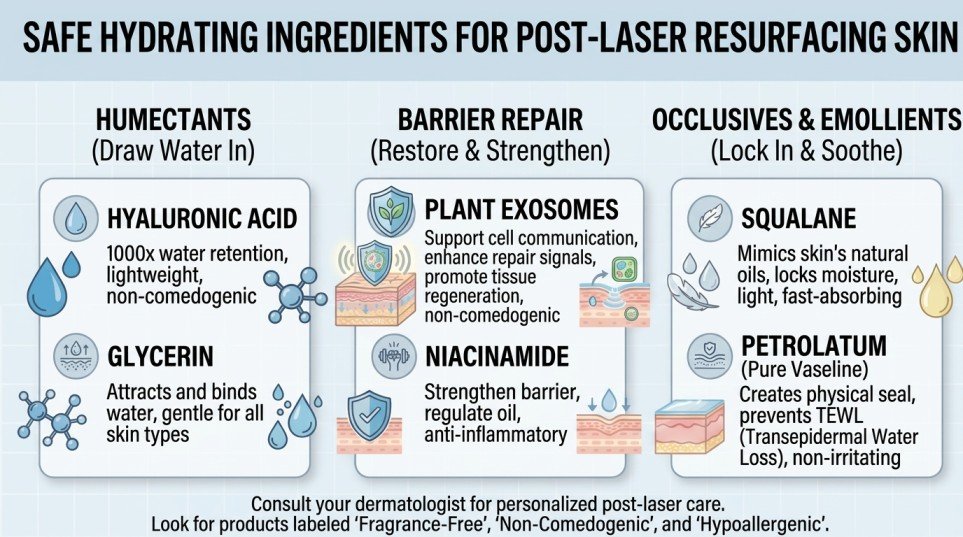
The key to post-laser hydration is distinguishing between humectants, which draw water into the skin, and heavy occlusives, which seal the surface. The most effective approach for healing skin combines lightweight humectants with targeted barrier-supporting ingredients.
Hyaluronic acid is your primary ally. This naturally occurring molecule holds up to one thousand times its weight in water, drawing moisture from the environment and deeper skin layers into the surface where dehydration is most acute. It is lightweight, non-comedogenic, and provides immediate relief from tightness without any risk of pore congestion. Look for serums or lightweight formulations rather than heavy creams as your hyaluronic acid delivery vehicle.
Glycerin is another powerful humectant that hydrates effectively without clogging pores. It attracts and binds water to the skin, supporting the moisture levels your barrier can no longer maintain on its own. Glycerin is well-tolerated by virtually all skin types and is commonly found in gentle, post-procedure formulations.
Niacinamide supports barrier repair while also helping regulate oil production, making it particularly valuable for patients concerned about congestion. It strengthens the lipid barrier that retains moisture and provides anti-inflammatory benefits that complement the healing process.
Panthenol, also known as provitamin B5, acts as both a humectant and an emollient. It draws moisture into the skin while softening and soothing the surface. Its anti-inflammatory properties make it especially appropriate during the early days of recovery when skin is most sensitive and most dehydrated.
Ceramides help restore the lipid layer of your barrier that was disrupted during treatment. By rebuilding this structural component, ceramides reduce transepidermal water loss at its source, helping your skin retain moisture more effectively as it heals. Ceramides are non-comedogenic and work by repairing the barrier rather than sitting heavily on the surface.
Textures and Formulations to Choose and Avoid
The texture of your moisturizing products matters as much as the ingredients inside them. During laser recovery, the goal is lightweight, breathable hydration that does not suffocate healing skin.
Gel-based and gel-cream moisturizers provide hydration with a lightweight feel that allows skin to breathe. These formulations typically rely on water and humectants rather than heavy oils, making them ideal for patients concerned about congestion. They absorb quickly and can be layered without creating a thick, pore-blocking film.
Lightweight serums, particularly those built around hyaluronic acid, deliver concentrated hydration in a thin, fast-absorbing vehicle. Applying a hydrating serum before a light moisturizer creates layered moisture without the heaviness of a single thick cream.
What to approach with caution: thick balms and petroleum-based ointments like Vaseline are sometimes recommended during the acute phase of ablative laser recovery to prevent crusting. If your practitioner has specifically instructed you to use an occlusive ointment, follow their guidance. However, transition to lighter formulations as soon as your practitioner advises, typically within the first few days. Prolonged use of heavy occlusives beyond the acute phase can contribute to milia, a type of small white bump caused by trapped keratin, and congestion.
Avoid moisturizers containing comedogenic oils like coconut oil, cocoa butter, or wheat germ oil. Also avoid products with fragrance, essential oils, or alcohol, all of which can irritate healing skin and compound the problem rather than solving it.
A Layering Strategy for Maximum Hydration
Rather than relying on one thick product, layering multiple lightweight hydrating steps delivers superior moisture without pore congestion. This approach is sometimes called the "sandwich method" and is especially effective during laser recovery.
Start with a hydrating serum. After gentle cleansing, apply a hyaluronic acid serum or a post-procedure serum containing humectants and barrier-supporting ingredients while your skin is still slightly damp. This locks in additional water at the surface level.
Follow with a lightweight, non-comedogenic moisturizer. Choose a gel-cream or lotion formula containing ceramides, niacinamide, or panthenol to reinforce the barrier and provide an additional layer of moisture retention.
During the day, finish with broad-spectrum mineral SPF 50 or higher. Many mineral sunscreens now include hydrating ingredients, providing an additional moisture layer while protecting your vulnerable skin from UV damage.
Reapply throughout the day as needed. During the acute phase of recovery, your skin may need product application every few hours. Keeping a hydrating mist or a small amount of your serum available for midday touch-ups prevents the skin from ever feeling parched.
Supporting Hydration at the Cellular Level
Surface hydration addresses the symptoms of post-laser dehydration, but the most effective recovery also supports the biological processes that restore your barrier's ability to retain moisture independently. When your cells have the energy and materials they need to rebuild efficiently, your transepidermal water loss normalizes sooner and the period of extreme dehydration shortens.
During days one through seven, apply Nexovia Skin Serum at 1mL in the morning and 1mL at night. The ABA.4 Aesthetic Bio-Amplifier architecture delivers plant exosomes to modulate inflammation, PDRN to activate tissue regeneration, NAD+ to fuel cellular energy for barrier reconstruction, and a peptide matrix to rebuild the extracellular framework. Follow with your lightweight moisturizer and broad-spectrum SPF 50 or higher during the day.
During days eight through fourteen, apply Nexovia at 0.5mL in the morning and 0.5mL at night as your barrier continues restoring and your hydration needs begin normalizing.
After day fourteen, continue applying Nexovia once daily until the 30mL bottle is finished to maintain results and support ongoing skin health.
Choosing Aftercare That Hydrates and Heals Simultaneously
The most efficient approach to post-laser hydration is using products that address both the symptom of dehydration and the underlying cause of barrier disruption in one step.
This is exactly why Nexovia's Skin Serum was formulated with its ABA.4 Aesthetic Bio-Amplifier architecture. The formula combines plant exosomes at 4 billion particles per milliliter, PDRN at 1% concentration, NAD+ at 1% concentration, and a peptide matrix including growth factors. This bio-intelligent aftercare addresses recovery from multiple angles simultaneously, designed to soothe instantly, support barrier recovery, and amplify your final results.
Made in South Korea and developed specifically for the post-procedure experience, Nexovia represents the next generation of aftercare formulated to work with your skin's natural healing processes.
Nexovia Skin Serum launches in June 2026. Register for early access to be among the first to experience bio-intelligent aftercare designed specifically for post-procedure recovery.
Frequently Asked Questions
How often should I moisturize after laser resurfacing?
During the first few days of recovery, you may need to apply hydrating products every two to three hours to prevent your skin from feeling tight and dry. As your barrier begins rebuilding, typically after the first week, you can transition to applying morning and evening with occasional midday touch-ups. The key indicator is how your skin feels. If it feels tight or uncomfortable, it needs more moisture. Never allow your skin to dry out during the healing process.
Can I use Vaseline after laser resurfacing?
Some practitioners recommend petroleum-based ointments like Vaseline during the first two to three days after ablative laser resurfacing to prevent crusting and maintain a moist healing environment. If your practitioner instructs you to use it, follow their guidance for the specified period. However, transition to lighter, non-comedogenic formulations as soon as advised. Prolonged use of heavy occlusives beyond the acute phase can trap debris and contribute to milia or breakouts.
My skin is breaking out after laser resurfacing. Is this from my moisturizer?
Post-laser breakouts can have several causes. Your moisturizer may be too heavy or contain comedogenic ingredients, but breakouts can also result from the healing process itself as cellular debris and shedding skin can temporarily congest pores. Switching to a lighter, non-comedogenic formulation often helps. If breakouts persist or worsen, contact your practitioner, as they may recommend a gentle approach to managing them without disrupting your healing.
Is drinking more water enough to hydrate my skin after laser?
Internal hydration supports overall health and healing, but it cannot compensate for the increased transepidermal water loss that occurs after laser resurfacing. Your skin needs topical hydration delivered directly to the surface to counteract the moisture escaping through the compromised barrier. Think of internal hydration and topical hydration as complementary strategies. Both are important, but topical products are essential for addressing the acute dehydration your skin is experiencing.
When will my skin stop feeling so dry after laser resurfacing?
The duration of intense dryness depends on the type and intensity of your laser treatment. Non-ablative treatments may cause noticeable dryness for one to two weeks. Lighter ablative procedures typically involve dehydration lasting two to three weeks. More intensive ablative resurfacing can leave skin feeling drier than usual for several weeks as the barrier progressively rebuilds. Consistent hydration and barrier-supporting aftercare can meaningfully shorten this timeline.
This content is for informational purposes only and does not constitute medical advice. Always follow the specific aftercare instructions provided by your practitioner, as recommendations may vary based on your individual treatment and skin type.


