Journal
How to Calm Swelling After RF Microneedling: What's Normal and What's Not
You wake up the morning after your RF microneedling session, look in the mirror, and barely recognize yourself. Your face is puffy, your cheeks look swollen, and the skin...
April 23, 2026 / 9 min read

You wake up the morning after your RF microneedling session, look in the mirror, and barely recognize yourself. Your face is puffy, your cheeks look swollen, and the skin around your eyes feels tight. The immediate thought is that something went wrong. Your mind jumps to worst-case scenarios, and you are already reaching for your phone to call the clinic before you have even had your coffee.
Take a breath. Swelling after RF microneedling is one of the most common and most expected side effects of the treatment. In the vast majority of cases, it is a healthy sign that your body's inflammatory response has been activated, which is exactly what drives the collagen remodeling and skin tightening that RF microneedling is designed to deliver. However, understanding the difference between normal post-treatment swelling and signs that warrant professional attention gives you peace of mind and helps you manage your recovery confidently.
Why RF Microneedling Causes More Swelling Than Traditional Microneedling
RF microneedling combines two mechanisms of action. Like traditional microneedling, it creates thousands of controlled micro-punctures in the skin. But it adds a second layer of controlled injury by delivering radiofrequency energy through the needles into the deeper dermis. This thermal energy heats the tissue, causing collagen contraction and triggering a more intensive remodeling response than needling alone.
Because RF microneedling involves both mechanical and thermal injury, the body's inflammatory response is more pronounced. Your immune system sends increased blood flow, fluids, and healing mediators to the treated area. This accumulation of fluid in the tissue is what you see and feel as swelling. It is the same biological mechanism that causes a sprained ankle to puff up, but in this case, the inflammation is intentional and productive.
The depth and intensity of your treatment, the energy settings used, and your individual skin type all influence how much swelling you experience. Some patients notice only mild puffiness, while others wake up with significant facial swelling that can feel alarming if they were not expecting it.
The Normal Swelling Timeline
Understanding what to expect day by day helps you distinguish between a healthy healing trajectory and something that may need attention.
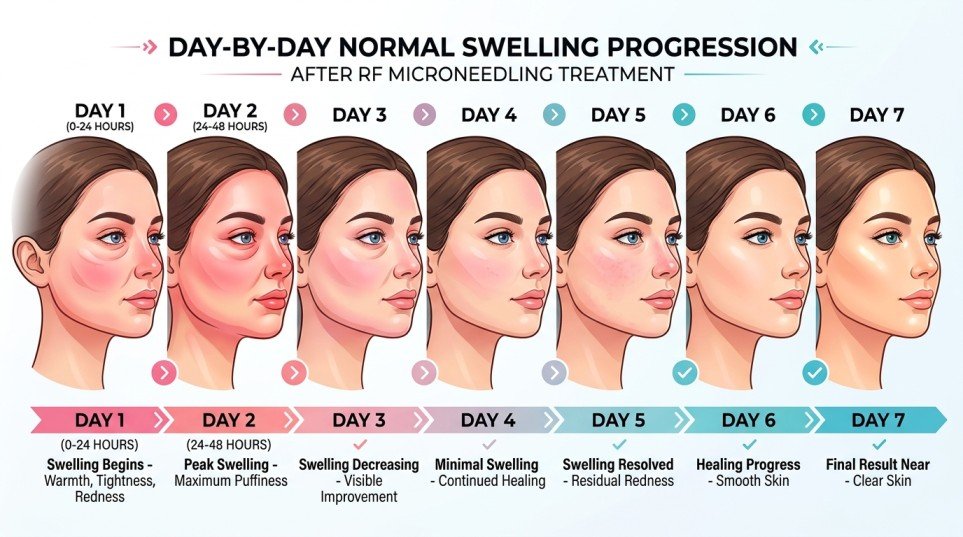
During the first 24 hours, swelling typically begins within a few hours of treatment and intensifies as the inflammatory response builds. Your face may feel warm, tight, and noticeably puffy, particularly around the eyes, cheeks, and jawline where tissue is naturally softer. This is accompanied by redness that resembles a moderate sunburn. All of this is expected.
Between 24 and 48 hours, swelling generally reaches its peak. This is when patients are most likely to feel concerned because puffiness is at its most visible. It is important to know that peak swelling at this stage is completely normal and does not indicate a problem. Your body is working hardest during this window to deliver healing resources to the treated tissue.
From days three through five, you should notice a steady and visible decrease in swelling. Puffiness begins resolving, though some areas may reduce faster than others. Redness is also fading during this phase, shifting from an intense flush to a milder pink tone.
By the end of the first week, most noticeable swelling should have fully resolved. Some patients with sensitive skin or those who received more intensive treatment settings may retain very mild puffiness slightly longer, but the trajectory should be clearly improving.
How to Calm Swelling Effectively
While swelling will resolve on its own as part of the natural healing process, several strategies can help manage discomfort and support a smoother recovery.
Use cool compresses, not ice. Applying a cool, damp cloth to swollen areas provides relief without the risk of damaging sensitive, barrier-compromised skin. Avoid placing ice directly on your face, as extreme cold can constrict blood vessels too aggressively and potentially interfere with healing. A soft cloth dampened with cool water, applied gently for ten to fifteen minutes at a time, is the safer approach.
Elevate your head while sleeping. Fluid naturally gravitates downward, which is why facial swelling often looks worse in the morning. Sleeping with your head elevated on an extra pillow for the first two to three nights helps reduce overnight fluid accumulation and can make a noticeable difference in morning puffiness.
Avoid heat exposure. Hot showers, saunas, steam rooms, and intense exercise all increase blood flow and body temperature, which can worsen swelling. Keep your environment cool and avoid activities that raise your core temperature for at least 48 to 72 hours after treatment.
Stay hydrated. Drinking adequate water supports your body's ability to manage inflammation and flush excess fluids. While it may seem counterintuitive, proper hydration actually helps reduce swelling rather than contributing to it.
Avoid NSAIDs for the first 48 hours. This is an important distinction that many patients miss. Anti-inflammatory medications like ibuprofen and aspirin can interfere with the intentional inflammatory response that drives collagen remodeling. The swelling is part of the healing process that ultimately delivers your results. If you need pain relief, acetaminophen is a safer option that manages discomfort without suppressing the productive inflammatory cascade. Always confirm with your practitioner.
When Swelling Is Not Normal
While swelling itself is expected, certain patterns should prompt you to contact your practitioner for guidance.
Swelling that continues worsening after 48 hours rather than stabilizing or improving may indicate an unusual reaction that warrants evaluation. Normal swelling peaks at 24 to 48 hours and then steadily improves. An upward trajectory beyond that window is not typical.
Swelling accompanied by increasing pain is worth noting. Mild discomfort and tenderness are normal, but pain that intensifies rather than gradually subsides could signal a complication. The distinction is between manageable tenderness and pain that feels disproportionate or worsening.
Signs of infection require prompt attention. If you notice spreading redness beyond the treated area, pus or unusual discharge, fever, or streaking marks on the skin, contact your practitioner immediately. Infection after RF microneedling is uncommon when proper aftercare is followed, but early intervention is important if it occurs.
Severe blistering or burns are rare but possible if treatment settings were too aggressive for your skin type. Small, isolated areas of mild crusting can be normal, but widespread blistering should be evaluated by your practitioner.
Supporting Faster Swelling Resolution With Proper Aftercare
The ingredients you apply to your skin during recovery directly influence how efficiently your body manages the inflammatory process and rebuilds your barrier. Products designed for post-procedure skin provide targeted support that helps swelling resolve on its natural timeline without interference.
During days one through seven, apply Nexovia Skin Serum at 1mL in the morning and 1mL at night. The ABA.4 Aesthetic Bio-Amplifier architecture delivers plant exosomes to modulate inflammation and support intercellular communication, PDRN to activate tissue regeneration pathways, NAD+ to fuel the intensive cellular energy demands of repair, and a peptide matrix to rebuild the structural framework of your skin. Follow with a bland moisturizer and broad-spectrum SPF 50 or higher during the day.
During days eight through fourteen, apply Nexovia at 0.5mL in the morning and 0.5mL at night as your skin completes its restoration.
After day fourteen, continue applying Nexovia once daily until the 30mL bottle is finished to support ongoing collagen maturation and skin health.
Choosing Aftercare That Supports the Healing Process
When your aftercare is formulated to work with your body's natural inflammatory and repair mechanisms rather than against them, recovery feels more comfortable and swelling resolves within its expected window.
This is exactly why Nexovia's Skin Serum was formulated with its ABA.4 Aesthetic Bio-Amplifier architecture. The formula combines plant exosomes at 4 billion particles per milliliter, PDRN at 1% concentration, NAD+ at 1% concentration, and a peptide matrix including growth factors. This bio-intelligent aftercare addresses recovery from multiple angles simultaneously, designed to soothe instantly, support barrier recovery, and amplify your final results.
Made in South Korea and developed specifically for the post-procedure experience, Nexovia represents the next generation of aftercare formulated to work with your skin's natural healing processes.
Nexovia Skin Serum launches in June 2026. Register for early access to be among the first to experience bio-intelligent aftercare designed specifically for post-procedure recovery.
Frequently Asked Questions
Is swelling worse after RF microneedling than regular microneedling?
Yes, RF microneedling typically produces more swelling than traditional microneedling because it combines mechanical needle injury with thermal radiofrequency energy delivered into the deeper dermis. This dual mechanism creates a more intensive inflammatory response, which is also what makes RF microneedling particularly effective for skin tightening and collagen remodeling. The additional swelling is a sign that the deeper tissue is responding to treatment.
Can I use ice on my face after RF microneedling?
Cool compresses are recommended, but direct ice application is generally discouraged. Extreme cold can constrict blood vessels too aggressively and potentially damage sensitive, barrier-compromised skin. A soft cloth dampened with cool water applied gently for ten to fifteen minutes at a time provides effective relief without the risks associated with ice. Some practitioners may provide specific guidance on cold therapy, so always follow their instructions.
Why is my swelling worse in the morning after RF microneedling?
Fluid naturally pools in areas where gravity directs it. When you sleep lying flat, fluids accumulate in your face overnight, making swelling appear worse when you first wake up. Sleeping with your head elevated on an extra pillow for the first two to three nights helps minimize this effect. Morning swelling that improves throughout the day as you are upright is a normal pattern and not a cause for concern.
Should I take ibuprofen for swelling after RF microneedling?
Most practitioners advise against NSAIDs like ibuprofen and aspirin for at least 48 hours after RF microneedling. These medications suppress the inflammatory response, which sounds helpful but can actually interfere with the productive inflammation that drives collagen remodeling and skin tightening. Acetaminophen is typically recommended as a safer alternative for managing discomfort without dampening the healing cascade. Always confirm with your practitioner before taking any medication after treatment.
How long until I see the final results from RF microneedling?
While swelling resolves within the first week, the full results of RF microneedling develop over a longer timeline. Initial improvements in skin texture and tightness may be visible within two to three weeks as surface healing completes. However, collagen remodeling continues for three to six months, with results progressively improving throughout this period. Patience during this maturation phase is essential, as the most impressive changes often appear weeks after your skin looks visually healed.
This content is for informational purposes only and does not constitute medical advice. Always follow the specific aftercare instructions provided by your practitioner, as recommendations may vary based on your individual treatment and skin type.


