How Long Until I See Final Results? Setting Realistic Expectations After Aesthetic Treatments

Opens by describing the experience most patients share: a week after the procedure, the redness has faded, the skin looks smoother, and there is an encouraging glow. But the question that follows is always the same, is this it, or will it keep improving? The answer is almost always yes, it keeps improving, but on a timeline that is much longer than most people expect. Aesthetic procedures that stimulate collagen work beneath the surface over weeks and months, not days. Understanding the real timeline for results removes the frustration of waiting and helps patients appreciate improvements as they gradually emerge rather than feeling disappointed by week two. This guide provides honest, procedure-specific timelines for when to expect visible changes and when final results are typically reached.
Why Results Take Time: The Science of Collagen Remodeling
Explains that most aesthetic procedures, whether microneedling, laser resurfacing, chemical peels, RF microneedling, or IPL, work by creating a controlled injury that triggers the body's wound-healing response. This response unfolds in three overlapping phases. The inflammatory phase begins immediately and peaks within 48 to 72 hours. This is the redness, swelling, and warmth patients see in the mirror during the first few days. The proliferative phase follows, running from approximately day three through day 21. During this stage, fibroblasts begin producing new collagen and elastin, new blood vessels form, and the skin barrier starts rebuilding. The early glow that many patients notice around week one or two is a result of this fresh cellular activity. The remodeling phase is where the real transformation happens, and it is also the longest and most invisible. Newly formed collagen fibers are reorganized, cross-linked, and strengthened over a period of weeks to months. This is the phase responsible for improvements in skin firmness, scar depth, pore size, and overall texture that patients notice at the two-month, three-month, or even six-month mark. The remodeling phase can continue for up to 12 months for certain procedures. The takeaway is that what you see at one week is the beginning of the result, not the final result.
Procedure-Specific Timelines
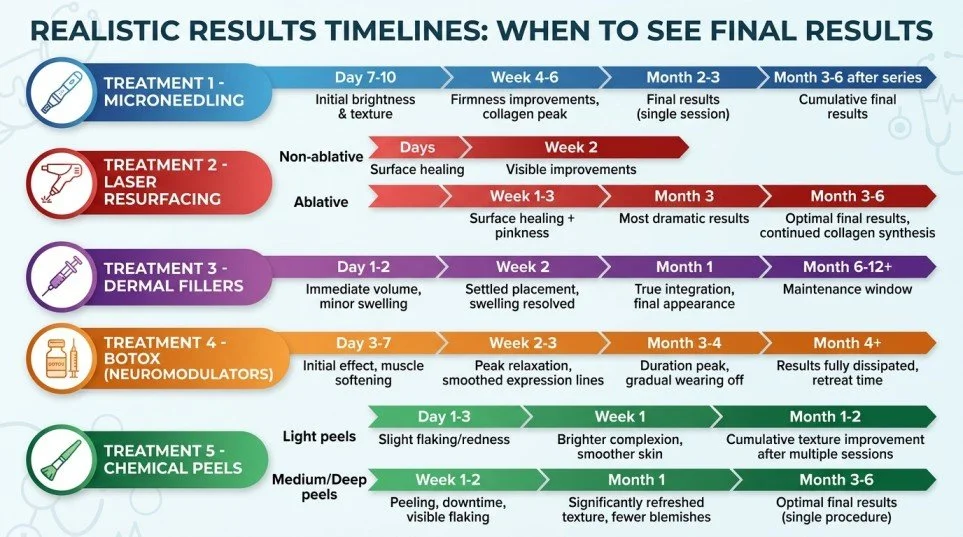
Provides detailed timelines for each of the five procedures Nexovia targets.
After microneedling:
Initial improvements in brightness and texture are often visible within seven to ten days as surface healing completes. More significant changes in firmness, fine lines, and scar appearance begin to emerge at the four to six week mark as collagen production peaks. Final results from a single session are typically reached at two to three months. For a series of three to six sessions spaced four to six weeks apart, the cumulative final result is usually visible three to six months after the last session.
After laser resurfacing:
Surface healing for non-ablative laser is usually complete within a few days with visible improvement in tone and texture by week two. For ablative laser, surface healing takes one to three weeks, and residual pinkness can persist for several weeks to months, which is normal. Collagen remodeling continues for three to six months, with some patients reporting ongoing improvements up to 12 months after treatment. The most dramatic improvements in wrinkles, scars, and skin texture are typically visible at the three-month mark.
After a chemical peel:
Light peels show a fresh glow within three to five days, with best results after a series of treatments spaced two to four weeks apart. Medium peels produce visible improvements in tone and texture within one to two weeks, with continued collagen-related improvements over four to six weeks. Deep peels require the longest recovery, with surface healing taking up to two weeks and collagen remodeling continuing for two to six months.
After RF microneedling:
Noticeable improvements in skin tightness and texture begin at two to four weeks. The most significant results are typically seen at six to twelve weeks as collagen production from the radiofrequency energy peaks. Full collagen remodeling and skin tightening continue for up to six months. Most patients require three to four sessions for optimal results.
After IPL:
Pigmentation and redness improvements are often visible within one to two weeks as treated spots darken, flake off, and reveal clearer skin underneath. A series of three to five sessions spaced three to four weeks apart is standard, with cumulative results building over the treatment course. Final evenness in tone is typically reached four to six weeks after the last session.
Factors That Influence How Quickly You See Results
Explains that the timelines above are general ranges, and individual results vary based on several factors. Age plays a significant role because collagen production naturally slows with age. Research published in Biomedicines found that aging prolongs the inflammatory phase and increases oxidative stress during healing, which means older patients may take longer to reach final results but can still achieve excellent outcomes with patience. Skin type and condition matter because thicker, more resilient skin may heal faster while sensitive or previously compromised skin takes longer. The intensity and depth of the treatment also affect the timeline: a light superficial peel produces quicker but more modest results, while a deep ablative laser takes longer to heal but produces more dramatic transformation. Lifestyle factors contribute significantly. Adequate sleep, hydration, balanced nutrition (particularly vitamins C and E, zinc, and omega-3 fatty acids), and avoiding smoking all support collagen synthesis and faster healing. Smoking is particularly damaging because nicotine constricts blood vessels, reducing the oxygen delivery that healing tissue needs. Sun exposure works against results by breaking down newly formed collagen and triggering pigment irregularities that the treatment was designed to correct. Aftercare compliance is one of the most controllable variables. Patients who follow their practitioner's aftercare instructions consistently and protect their skin during recovery tend to see results faster and maintain them longer.
Why Multiple Sessions Often Produce Better Results
Explains that many aesthetic procedures are designed to work cumulatively. Each session builds on the collagen foundation laid by the previous one. A single microneedling session can produce noticeable improvement, but a series of three to six sessions creates a compounding effect where each round of collagen production adds to the structural gains of the last. This is why practitioners design treatment plans rather than relying on individual sessions. Setting expectations for the full treatment course rather than judging results from a single session prevents premature disappointment and helps patients commit to the plan that will deliver their best outcome.
How Aftercare Supports Faster, Longer-Lasting Results
Describes that what happens in the days and weeks following a procedure directly influences how much collagen the skin produces and how well it matures. Supporting the skin during the proliferative and remodeling phases with appropriate ingredients can help maximize the return on the investment of time, cost, and downtime.
Nexovia Skin Serum was designed to support the skin during the entire post-procedure timeline , from the acute inflammatory phase through to the extended remodeling phase. Its ABA.4 Aesthetic Bio-Amplifier architecture delivers four bio-active pillars working in concert: plant exosomes at 4 billion particles per milliliter provide multi-signal communication that supports barrier repair, calms inflammation, and promotes collagen synthesis during the proliferative phase. PDRN at 1 percent supports cellular repair and DNA synthesis during the critical early days of recovery. NAD+ at 1 percent fuels the cellular energy needed for sustained collagen production throughout the remodeling phase. The peptide matrix with growth factors reinforces the collagen remodeling triggered by each procedure, supporting the maturation and cross-linking process that determines the quality and longevity of the final result. The protocol mirrors the healing timeline itself: Days 1–7 apply 1 mL morning and night during the acute phase when cellular activity is highest. Days 8–14 reduce to 0.5 mL morning and night as the skin transitions from repair to remodeling. After day 14 continue with 1 mL once daily until the 30 mL bottle is finished, supporting the extended collagen maturation process. Made in South Korea, Nexovia Skin Serum launches in June 2026 with early-access registration available.
Frequently Asked Questions
-
Offers practical advice for patients who want objective evidence that their results are developing. Take a baseline photo before the procedure, then follow-up photos at one week, two weeks, four weeks, and three months, always using the same lighting, angle, and distance. Side-by-side comparison reveals gradual changes that are impossible to notice in the mirror day to day. Keep a brief written log noting how the skin feels, tightness, texture, sensitivity, alongside each photo. This combination of visual and tactile tracking provides tangible proof of progress during the long remodeling window when improvements are happening beneath the surface.
-
Yes. At one week, the skin has completed its initial surface healing and may look brighter, but the most significant collagen-related improvements happen between four and twelve weeks. What you see at week one is the beginning, not the end, of the transformation.
-
Cumulative sessions build on each other. Each round of controlled injury triggers a new cycle of collagen production that adds to the foundation laid by previous sessions. This stacking effect produces results that are more dramatic, more even, and longer lasting than a single aggressive treatment, with less risk of complications.
-
You cannot speed up the biological process of collagen remodeling, but you can ensure it proceeds without interference. Consistent aftercare, daily mineral sunscreen, adequate hydration, balanced nutrition, quality sleep, and avoiding smoking all support optimal collagen production. Using a post-procedure serum that supports the skin's repair and remodeling pathways can help ensure the healing process is as efficient as possible.
-
This depends on the procedure and individual factors. Microneedling results typically last six to twelve months before a maintenance session is recommended. Laser resurfacing results can last several years with proper skincare. Chemical peel results last one to six months depending on the peel depth. RF microneedling results can persist for one to two years. All results are influenced by ongoing sun protection, skincare routine, and natural aging.
-
Discuss your concerns with your practitioner. In many cases, an additional session or an adjustment to the treatment plan can address remaining concerns. It is important to wait until the full collagen remodeling timeline has passed before evaluating final results, as judging outcomes too early can lead to unnecessary additional treatments.
This content is provided for informational purposes only and does not constitute medical advice. Always follow your practitioner's specific aftercare instructions and treatment plan recommendations.
