Journal
Exosomes vs Growth Factors: Understanding the New Generation of Skin Recovery
Opens by noting that anyone researching post-procedure skincare has likely seen the terms "exosomes" and "growth factors" appearing with increasing frequency. Both are...
May 7, 2026 / 8 min read

Opens by noting that anyone researching post-procedure skincare has likely seen the terms "exosomes" and "growth factors" appearing with increasing frequency. Both are positioned as next-generation ingredients for skin recovery and rejuvenation, but they are not the same thing. Understanding how they differ, where they overlap, and what makes each one valuable helps you make informed choices about what you apply to skin that is actively healing after microneedling, laser resurfacing, chemical peels, IPL, or RF microneedling. This guide breaks down the science behind each ingredient in clear, practical terms.
What Are Growth Factors?
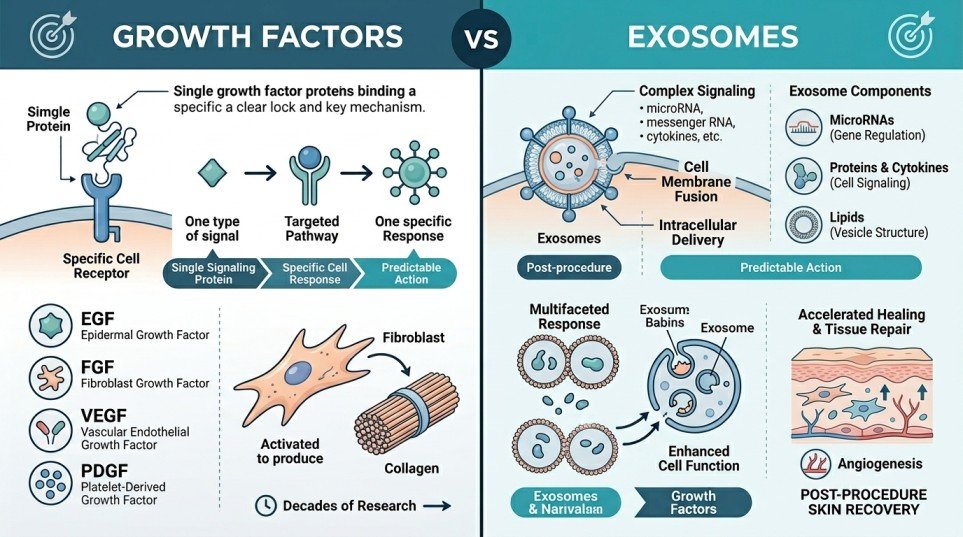
Growth factors are naturally occurring signaling proteins found in the skin, blood, and connective tissues. Their primary role is to coordinate tissue repair by activating fibroblasts, the cells responsible for producing collagen, elastin, and other structural proteins that keep skin firm, smooth, and resilient. Common types include EGF (epidermal growth factor), FGF (fibroblast growth factor), VEGF (vascular endothelial growth factor), and PDGF (platelet-derived growth factor). When applied topically, growth factors supplement the skin's declining natural supply, helping to stimulate collagen synthesis, support the renewal cycle, and gradually improve firmness, texture, and elasticity. Growth factors have decades of research behind them and are considered one of the most established technologies in advanced skincare. They work through a targeted, single-pathway mechanism, each growth factor type sends a specific signal to a specific cell type, producing a predictable and well-studied response.
What Are Exosomes?
Exosomes are tiny membrane-bound vesicles, roughly 30 to 150 nanometers in diameter, that cells naturally release as part of intercellular communication. What makes exosomes distinctive is not the vesicle itself, but what it carries inside: a concentrated cargo of peptides, proteins, lipids, cytokines, growth factors, and various forms of RNA including microRNA. This cargo acts as a set of instructions that tells receiving cells how to behave, whether to ramp up collagen production, reduce inflammation, accelerate repair, or strengthen the barrier. Unlike individual growth factors that send a single signal, exosomes deliver a multi-signal payload simultaneously. They can be derived from various sources including human stem cells, plant cells, or other biological origins. Plant-derived exosomes have gained particular attention in skincare because they avoid the regulatory and ethical complexities of human-derived sources while still carrying bioactive signaling molecules that the skin can recognize and respond to.
How They Differ: Single Signal vs Multi-Signal
The most important distinction between growth factors and exosomes is the breadth of their communication. Growth factors operate through a single-pathway mechanism: one protein, one receptor, one response. EGF tells epidermal cells to proliferate. FGF tells fibroblasts to produce collagen. This targeted approach is effective but limited to one action at a time. Exosomes, by contrast, deliver a diverse set of molecules in a single delivery. One exosome can carry growth factors, anti-inflammatory cytokines, and repair-signaling RNA simultaneously. This means exosomes can support multiple healing pathways at once, calming inflammation while also promoting collagen synthesis and strengthening the barrier. For post-procedure skin that is managing several recovery processes simultaneously, this multi-signal approach is particularly relevant because the skin is not dealing with a single issue after a treatment. It is repairing its barrier, rebuilding collagen, managing inflammation, and stabilizing pigment activity all at the same time.
Why Source and Concentration Matter
Not all exosome and growth factor products are equal. The effectiveness of a growth factor serum depends on the type, stability, and concentration of the proteins included. Many products list growth factors on the label but at concentrations too low to produce meaningful results. Similarly, the term "exosomes" has become a marketing buzzword, and some products use it without specifying the source, particle count, or payload content. When evaluating any product in this category, looking for transparency around concentration (particles per milliliter for exosomes, ppm or percentage for growth factors), source origin, and the presence of supporting ingredients is essential. A well-formulated product will pair its primary active with complementary ingredients that enhance stability, delivery, and overall efficacy.
The Role of PDRN and NAD+ Alongside Exosomes
Two ingredients frequently discussed alongside exosomes in regenerative skincare are PDRN (polydeoxyribonucleotide) and NAD+ (nicotinamide adenine dinucleotide). PDRN is a DNA fragment, typically derived from salmon, that supports cellular repair at the DNA level. It helps activate the A2A adenosine receptor, which plays a role in reducing inflammation and stimulating tissue regeneration. In clinical settings, PDRN has been used for wound healing for years, and in topical skincare it contributes to hydration, soothing, and mild repair support. NAD+ is a coenzyme found in every living cell that fuels cellular energy production. During post-procedure recovery, skin cells are working harder than usual to repair damage, synthesize new collagen, and restore the barrier. NAD+ levels naturally decline with age and stress, so supplementing them topically can help cells maintain the energy they need during the metabolically demanding recovery period. When exosomes, PDRN, and NAD+ are combined in a single formulation, the result is a multi-layered approach: exosomes deliver the communication signals, PDRN supports DNA-level repair, and NAD+ provides the cellular fuel to power the entire recovery process.
Where Nexovia Skin Serum Fits In
Nexovia Skin Serum was designed around this multi-layered philosophy. Its ABA.4 Aesthetic Bio-Amplifier architecture combines all four bio-active pillars into a single post-procedure formulation: plant exosomes at a concentration of 4 billion particles per milliliter to deliver multi-signal repair communication, PDRN at 1 percent to support cellular repair and DNA synthesis, NAD+ at 1 percent to fuel cellular energy during recovery, and a peptide matrix with growth factors to reinforce the collagen remodeling triggered by aesthetic treatments. Rather than choosing between exosomes or growth factors, the ABA.4 architecture uses both, alongside PDRN and NAD+, so that recovering skin receives comprehensive support across all healing pathways simultaneously. The recommended protocol: Days 1-7 apply 1 mL morning and night to clean skin, followed by a bland moisturizer and mineral SPF 50+ during the day. Days 8-14 reduce to 0.5 mL morning and night as the skin transitions from acute recovery to remodeling. After day 14, continue with 1 mL once daily until the 30 mL bottle is finished.
Nexovia Skin Serum is made in South Korea and launches in June 2026. Early-access registration is available now.
Frequently Asked Questions
Which One Is Right for Your Skin?
Growth factors are an excellent choice for those focused on long-term firmness and elasticity, particularly for mature skin or anyone looking to support collagen production as part of a daily anti-aging routine. Results are gradual and cumulative, typically becoming visible over 8 to 12 weeks of consistent use. Exosomes are particularly well-suited for post-procedure recovery scenarios where the skin is managing multiple healing processes at once. Their multi-signal delivery supports faster visible calming, reduced redness, and more efficient barrier repair in the days and weeks following treatment. Research suggests exosomes can reduce healing times by 30 to 50 percent compared to PRP alone. For those recovering from aesthetic procedures like microneedling, laser, chemical peels, IPL, or RF microneedling, a formulation that combines exosomes with growth factors, PDRN, and NAD+ addresses the broadest range of recovery needs in a single step.
Are exosomes safer than growth factors?
Both are generally well-tolerated in topical skincare. The safety of any product depends on its source, formulation quality, and concentration rather than the category of ingredient. Plant-derived exosomes avoid concerns associated with human-derived biological materials. Growth factors have a longer track record in dermatological research. Neither category is inherently safer or more dangerous than the other, what matters is the transparency and quality of the specific product.
Can I use a growth factor serum and an exosome serum at the same time?
Yes, these ingredients can complement each other. Growth factors provide targeted collagen and repair signals while exosomes deliver broader cellular communication. Layering them is generally safe, though during the first week of post-procedure recovery it is often better to use a single well-formulated product rather than multiple serums to avoid overwhelming healing skin.
How quickly will I see results from exosomes after a procedure?
Many patients report visible calming of redness and improved skin comfort within the first few days of use. More structural improvements like enhanced firmness and texture develop over several weeks as collagen remodeling progresses. Full results from exosome therapy can continue improving for three to six months.
Do exosomes replace the need for growth factors in my routine?
Not necessarily. Exosomes carry growth factors as part of their cargo, so there is natural overlap. However, dedicated growth factor serums may provide higher concentrations of specific proteins like EGF or FGF. For comprehensive post-procedure support, a formulation that includes both exosomes and growth factors, like Nexovia's ABA.4 architecture, covers the widest range of recovery pathways.
What should I look for on the label when choosing an exosome product?
Look for transparency around the exosome source (plant-derived, stem cell-derived), particle count per milliliter, and the presence of complementary active ingredients. Avoid products that use the word "exosomes" without specifying concentration or origin. A trustworthy formulation will clearly state its particle count and active ingredient percentages.
This content is provided for informational purposes only and does not constitute medical advice. Always follow your practitioner's specific aftercare instructions.


