Journal
Microneedling for Acne Scars: Aftercare Tips to Maximize Scar Improvement
You have been living with acne scars long enough. You finally committed to microneedling because you heard it could genuinely improve the texture and appearance of scarred...
April 16, 2026 / 9 min read

You have been living with acne scars long enough. You finally committed to microneedling because you heard it could genuinely improve the texture and appearance of scarred skin, and now that the treatment is done, you are staring at a red, sensitive face wondering what comes next. The procedure itself was only the beginning. What you do during the days and weeks following each session plays an enormous role in how much scar improvement you actually see.
Microneedling for acne scars works by triggering your skin's collagen remodeling process, but that process takes time, and it needs the right conditions to deliver meaningful results. Rushing your recovery, using the wrong products, or neglecting key aftercare steps can slow down collagen production and diminish the outcome you invested in. This guide gives you the specific aftercare strategies that support maximum scar improvement after microneedling.
Why Aftercare Matters More for Acne Scars
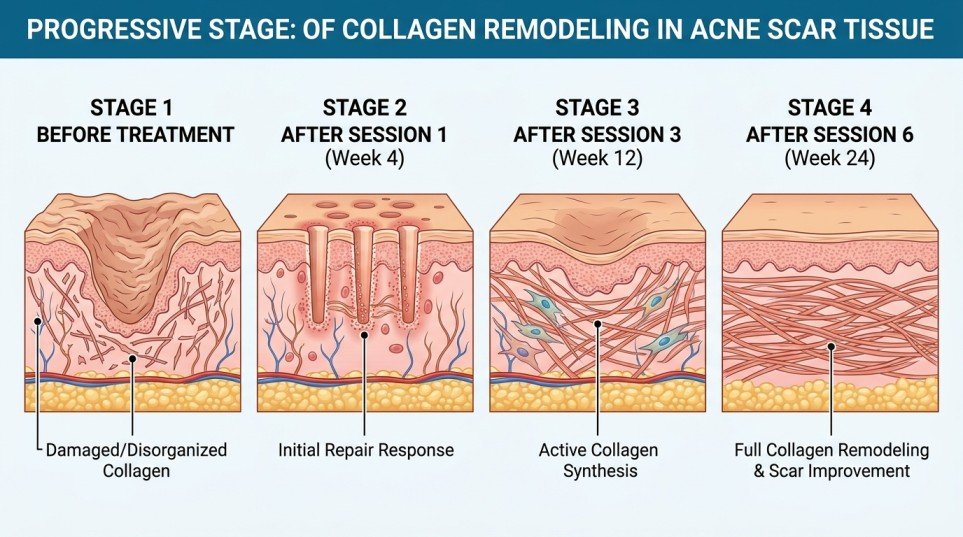
Microneedling creates thousands of controlled micro-injuries that initiate a wound healing cascade. Your body responds by releasing growth factors and activating fibroblasts, the cells responsible for producing collagen and elastin. Over time, this new collagen fills in depressed scar tissue, softens raised scars, and gradually smooths the skin's texture.
What makes acne scar treatment different from microneedling for general skin rejuvenation is that scar tissue is structurally distinct from normal skin. Acne scars involve disorganized collagen fibers, tethered tissue, and sometimes loss of volume beneath the surface. Microneedling breaks up this malformed collagen and stimulates your skin to replace it with healthier, more organized tissue. This remodeling process does not happen overnight. Collagen maturation continues for months after each session, which is why most patients need three to six treatments spaced four to six weeks apart for meaningful scar improvement.
Every decision you make during recovery either supports or hinders this collagen remodeling. Proper aftercare creates the optimal environment for your skin to rebuild efficiently, session after session, compounding results over time.
The First 72 Hours: Protecting Your Healing Window
The initial days after microneedling are when your skin is most vulnerable and most receptive. The micro-channels created during treatment remain open for several hours, providing direct access to deeper skin layers. This enhanced permeability is powerful when you apply the right ingredients, and problematic when you expose your skin to irritants, bacteria, or environmental stress.
During the first 24 hours, keep your routine minimal. Avoid touching your face, skip makeup entirely, and cleanse only with lukewarm water or a gentle, fragrance-free cleanser as directed by your practitioner. Your skin will appear red and feel warm, similar to a sunburn. This is a normal inflammatory response and a sign that your body's healing cascade has been activated.
During hours 24 through 72, your micro-channels are closing and your barrier is beginning to rebuild. Continue with gentle cleansing and focus on hydration. Avoid heat exposure including hot showers, saunas, and intense exercise. Sweat contains salt that can sting and irritate open micro-channels, and elevated body temperature amplifies inflammation that is already elevated from the procedure.
Ingredients That Support Scar Remodeling
The ingredients you apply during recovery play a direct role in how effectively your skin produces new collagen and reorganizes scar tissue. Single-ingredient products address one aspect of healing, but acne scar recovery involves multiple simultaneous challenges: inflammation needs calming, damaged tissue needs regeneration signals, cells need energy for repair, and the extracellular matrix needs rebuilding. The most effective approach combines complementary technologies that work together.
Plant exosomes support intercellular communication during repair, helping your skin cells coordinate the complex process of breaking down disorganized scar tissue and replacing it with healthy collagen. PDRN activates adenosine A2A receptors, initiating signaling pathways that promote tissue regeneration, wound healing, and pigmentation management, all of which are particularly relevant for acne-scarred skin. NAD+ fuels the cellular energy production required for the intensive work of collagen synthesis and tissue remodeling. Peptides and growth factors signal fibroblasts to ramp up collagen production and reinforce the extracellular matrix that gives skin its structural integrity.
Supporting ingredients like hyaluronic acid replenish moisture lost through increased transepidermal water loss, while niacinamide supports barrier repair and helps manage post-inflammatory discoloration that often accompanies acne scars.
What to Avoid During Recovery
Certain common skincare habits can undermine the collagen remodeling process that is essential for scar improvement. Retinoids, AHAs, BHAs, and other active exfoliants should be avoided for at least five to seven days after treatment. These ingredients accelerate cell turnover and can be irritating even on healthy skin. On a compromised barrier, they can trigger excessive inflammation, prolonged redness, and interfere with the organized collagen production your scars need.
Active forms of vitamin C like L-ascorbic acid are too acidic for freshly treated skin and should wait until your barrier has fully recovered. Benzoyl peroxide, physical scrubs, fragranced products, and alcohol-based toners all fall into the same category of ingredients that overwhelm healing skin.
Equally important is avoiding sun exposure without protection. UV radiation can trigger post-inflammatory hyperpigmentation, which is especially problematic for acne-scarred skin that is already prone to uneven pigmentation. Apply broad-spectrum SPF 50 or higher daily, even indoors, and reapply every two hours when spending time outside.
Do not pick at any peeling or flaking skin. This is particularly tempting when you are treating acne scars because you are already hyper-aware of your skin's texture. Premature removal of peeling tissue can damage the new collagen forming beneath and lead to uneven healing or additional scarring.
Building a Recovery Routine That Compounds Results
Because acne scar improvement requires multiple microneedling sessions, your aftercare routine is not a one-time effort. It is a repeated protocol that you follow after every session, and consistency across treatments is what allows results to build meaningfully over time.
During days one through seven after each session, apply Nexovia Skin Serum at 1mL in the morning and 1mL at night. The ABA.4 Aesthetic Bio-Amplifier architecture delivers plant exosomes to modulate inflammation, PDRN to activate tissue regeneration, NAD+ to fuel cellular repair, and a peptide matrix to signal fibroblast activity and collagen production. Follow with a bland moisturizer and broad-spectrum SPF 50 or higher during the day.
During days eight through fourteen, apply Nexovia at 0.5mL in the morning and 0.5mL at night as your skin completes its restoration phase and collagen remodeling continues beneath the surface.
After day fourteen, continue applying Nexovia once daily until the 30mL bottle is finished to support the ongoing collagen maturation that drives scar improvement between sessions.
Setting Realistic Expectations for Scar Improvement
Patience is one of the most important aftercare strategies for acne scars. Unlike treatments for general skin brightness or hydration where results appear quickly, scar remodeling is a gradual biological process. New collagen takes weeks to months to mature and organize. Most patients begin noticing visible texture improvements after their second or third session, with results continuing to build for several months after completing their treatment series.
Deeper scars like ice pick and boxcar types typically require more sessions than shallow rolling scars. Your practitioner will assess your specific scarring and recommend a treatment plan tailored to your needs. Following your aftercare protocol diligently after each session gives your skin the best conditions to maximize improvement at every stage.
Choosing Aftercare Designed for Scar Recovery
When your aftercare addresses the specific biological processes involved in scar remodeling, rather than just surface-level hydration, you give your skin a genuine advantage in producing the organized collagen that fills and smooths scarred tissue.
This is exactly why Nexovia's Skin Serum was formulated with its ABA.4 Aesthetic Bio-Amplifier architecture. The formula combines plant exosomes at 4 billion particles per milliliter, PDRN at 1% concentration, NAD+ at 1% concentration, and a peptide matrix including growth factors. This bio-intelligent aftercare addresses recovery from multiple angles simultaneously, designed to soothe instantly, support barrier recovery, and amplify your final results.
Made in South Korea and developed specifically for the post-procedure experience, Nexovia represents the next generation of aftercare formulated to work with your skin's natural healing processes.
Nexovia Skin Serum launches in June 2026. Register for early access to be among the first to experience bio-intelligent aftercare designed specifically for post-procedure recovery.
Frequently Asked Questions
How many microneedling sessions do I need for acne scars?
Most patients require three to six microneedling sessions to see meaningful improvement in acne scars, with treatments spaced four to six weeks apart. Mild, shallow scarring may respond well toward the lower end of that range, while deeper or more extensive scarring often requires additional sessions. Collagen remodeling continues for months after each treatment, so the full impact of your series becomes apparent gradually over time. Your practitioner will recommend a treatment plan based on your specific scar type and severity.
Will microneedling completely remove my acne scars?
Microneedling can significantly improve the appearance of acne scars, but it is important to set realistic expectations. Most patients see meaningful smoothing and softening of scar tissue, with studies showing notable improvement in texture and depth. However, complete removal of deep or long-standing scars is difficult to achieve with any single treatment modality. Your practitioner may recommend combining microneedling with other treatments for the best possible outcome depending on your specific scarring.
Can microneedling make acne scars worse?
When performed by a qualified practitioner with proper aftercare, microneedling should not make acne scars worse. However, poor aftercare, premature sun exposure, picking at healing skin, or using irritating products during recovery can lead to post-inflammatory hyperpigmentation or prolonged inflammation that temporarily worsens the appearance of scarring. Following your aftercare protocol carefully is the best way to ensure your results move in the right direction.
Should I wait until active acne clears before microneedling for scars?
Most practitioners recommend waiting until active breakouts in the treatment area have resolved before proceeding with microneedling. Needling over active acne lesions can spread bacteria, worsen inflammation, and potentially cause additional scarring. If you are managing ongoing acne, work with your practitioner to develop a plan that addresses active breakouts first before beginning scar-focused microneedling treatments.
What is the difference between microneedling for anti-aging versus acne scars?
The fundamental mechanism is the same, which is stimulating collagen through controlled micro-injury, but the treatment parameters and goals differ. Microneedling for acne scars typically uses deeper needle depths to reach the level of scar tissue and break up disorganized collagen fibers. It also generally requires more sessions than anti-aging microneedling because scar remodeling is a more complex biological process than stimulating collagen in otherwise healthy skin. The aftercare principles remain similar for both, with hydration, barrier support, sun protection, and avoidance of irritating ingredients being essential.
This content is for informational purposes only and does not constitute medical advice. Always follow the specific aftercare instructions provided by your practitioner, as recommendations may vary based on your individual treatment and skin type.


